
- Daily & Weekly newsletters
- Buy & download The Bulletin
- Comment on our articles
Related articles
Recent




Popular


Stadium damage, flares and blaze at Brussels football derby “raise important security questions”

Questions have been asked about stadium security following incidents at the Belgian Croky Cup Final staged at the King Baudouin Stadium in Brussels on Thursday evening.
The showpiece football fixture between RSC Anderlecht and Royal Union Saint-Gilloise (RUSG) was keenly awaited as it was the first cup final derby between the two clubs in the 70-year history of the competition.
It ended in a 3-1 victory for Union over their city rivals after 30 minutes’ extra time. Anderlecht lost for the fourth time in a row at the stadium and ended their ninth consecutive trophy-less season. Union now hope to clinch a league/cup double to round off another dominant season.
But for some, a lively and entertaining game was partly overshadowed by events off the pitch, with flares regularly being lit and thrown towards a host of firefighters on duty on the stadium’s running tracks.
The start of the game was delayed by several minutes as players and officials waited for the thick smoke enveloping the whole arena to clear after flares hurled from the end of the ground occupied by Anderlecht fans. There was also a short delay during the game itself after Anderlecht equalised near the end of normal time and smoke from flares once again engulfed much of the stadium.
City of Brussels’ alderwoman for sports, Florence Frelinx (MR), denounced “in the strongest possible terms” the damage observed, "particularly in the Anderlecht stand,” reports Belga.

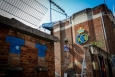
Photographs released by the City (pictured above) show numerous seats ripped out or destroyed, as well as debris and damage to material in several areas of the stadium. Nearly 300 seats were broken, according to Frelinx.
Kurt Deswert, a Brussels-based author and football historian who was in the stands on the night, told this website that the use of flares begs questions about security.
Speaking after the game, he said the image of a fire started in the Anderlecht fans’ end “may well be symbolic of yesterday’s defeat.”
According to the commentator, “The result of the [Anderlecht] supporters’ frustration was the fact that 300 seats were destroyed during the final. A metro train in the city was also damaged. As far as is currently known, no Brussels residents were attacked as they were last year (which remains a disgrace).
“However, the enormous quantity of pyrotechnic material once again smuggled into the stadium raises serious questions about the security preparations for the match and, more broadly, about how safety can be guaranteed during cup finals at the King Baudouin Stadium.”
Deswert observed Union shirts being set on fire in the same stand where the seats were vandalised. “It took the fire brigade a considerable amount of time to reach the scene and extinguish the blaze,” he said.
“Despite repeated appeals to keep the stairways clear, they remained packed with supporters throughout the entire match. This too raises important questions,” he pointed out.
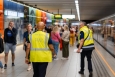
The police presence for the game was intense, with officers in riot gear patrolling the stadium, neighbouring streets and the transport network. Fans travelled on separate Metro lines in order to minimise the risk of trouble and it is believed there was no serious disorder outside the stadium, before or after the game.
For Deswert, there are also questions to be asked about the facilities at the Heysel pitch. “The King Baudouin Stadium is not a ruin, and it should not be described as such. But by design, it is still a stadium that falls well short of modern standards of comfort and safety. The entire renovation and maintenance dossier has been mishandled for years and urgently needs to be brought under control. The cup finals provide proof of that year after year.”
He pointed out: “In general, these are high-risk matches. There are not a lot of those being organised at the stadium but they have had the experience with the cup final last year and should have been better prepared this year. It seems to be a combination both of a structural issue with the stadium itself and the presence of ultra groups for games such as the cup final.
“Still, pyrotechnics is a growing issue in Belgian football these last couple of years and also during regular competition games,” noted Deswert.
This site contacted both the stadium authorities and the Belgian Football Association but at the time of going to press had not yet received a reply.
The City of Brussels confirmed that after a full inventory of the damage, it would send a bill to the club in question, according to Frelinx.
Union clinch victory during extra time

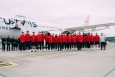
On the pitch, Union (pictured above) were deserved winners though they were taken to extra time before clinching another victory over their city rivals. The game means Anderlecht, the most successful club in Belgian football history with 34 league titles, still await their first piece of silverware since 2017 when it won the championship.
Last season, Anderlecht lost in the final to Club Brugge — where police had to cope with serious crowd disorder — and again four years ago (to Gent), under Bayern Munich's current Belgian-born head coach Vincent Kompany.
Before the game, the stadium was a cauldron of noise and colour thanks to fans of both clubs. Anderlecht supporters unveiled a huge banner that stretched the entire length of the stand reserved for them. It read 1070, the postal code for the municipality of Anderlecht, and below it, "Cup Fighters.” Union fans also displayed a large banner and, as usual, gave great vocal backing to their side.
Reflecting on the game, Deswert said it was a “a disappointing outcome for Anderlecht but Union were the deserved winners.”
He added: “A great deal can be said about the sporting side of things: the lack of leadership and technical fundamentals among some Anderlecht players — poor first touches, inaccurate passing — and the tactics, such as full-backs positioning themselves too high and too wide when possession is lost.”
But Deswert believes the match highlighted a difference in maturity on the pitch. “The new sporting director at Anderlecht will have to examine many aspects of the club.”
He also noted: “After 10 years without a trophy and with no apparent stable improvement, frustration among Anderlecht supporters is continuing to grow.
“The team was also booed by a considerable portion of its own supporters after the match — or at least by those who were partly responsible for the damage. Significantly, the defeat was not due to a lack of effort, but rather to a lack of quality within the squad.”
Photos: Stadium damage ©City of Brussels; Union victory ©RUSG Facebook page