

- Daily & Weekly newsletters
- Buy & download The Bulletin
- Comment on our articles
Related articles
Recent




Popular




Second annual Car-Free Sunday from May next year
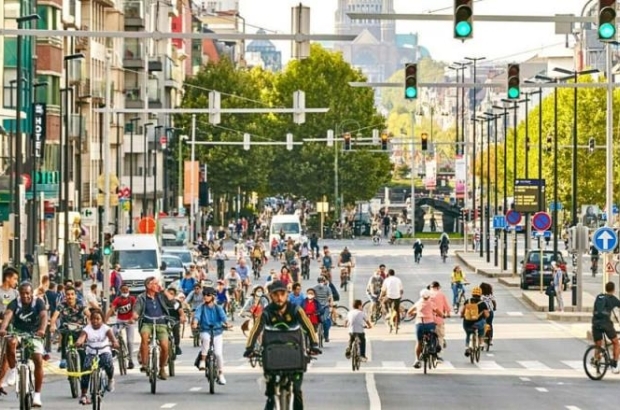
Brussels will have two Car-Free Sundays starting next year, with a new second annual edition tentatively scheduled for 9 May 2027, the Sunday of the Iris Festival weekend.
People have been calling for additional Car-Free Sundays for quite some time now, as the occasion becomes increasingly popular.
For one day and now two starting in 2027, the entire Brussels region will be closed to vehicular traffic (with exceptions, including for people with limited mobility) and residents take to the streets to walk, scoot, cycle or otherwise enjoy the city without car exhaust or traffic jams.
Brussels Minister-President Boris Dilliès (MR) said he saw Car Free Sunday as an opportunity to think more broadly about mobility in the capital.
“We need to make it more than just a pleasant day,” said Dilliès. “It’s also a chance to inform people and raise awareness about mobility in Brussels.”
The initiative is part of Good Move, the capital’s broader plan to tackle its issues with traffic jams and air pollution, which are among the very worst of European capitals.
But while mobility minister Elke Van den Brandt (Groen) has called for four Car Free Sundays to be organised each year, critics of Good Move are already balking at the addition of a second, especially since next year this is tentatively scheduled to fall on Mother’s Day.
The "Non au plan Good Move Committee", which represents various local associations, called the decision “incomprehensible given that the city is already largely paralysed by public works, the removal of parking spaces and constant traffic jams”.
According to the umbrella organisation, the priority must be to improve the flow of traffic for drivers and prioritise motorists over pedestrians and other road users.
“At some point, the ideological obsession against the car must stop,” the organisation said in a statement.
“The most unbelievable thing of all is the timing. That day would fall during the spring half-term for French-speaking schools, a period when many families take the opportunity to travel, visit relatives or spend time together.
"But above all, it would also coincide with Mother’s Day. In practical terms, this means that families who sometimes travel from afar to visit their mothers, parents or grandparents in Brussels will once again face roadblocks, restrictions and additional complications."
Critics argue that the Brussels government should have foreseen this clash in the 2027 calendar and the Schaerbeek civic party Ensemble 1030 believes that, with the one additional car-free Sunday, the MR party is “breaking its campaign promises regarding the defence of freedom of movement”.
Dilliès said that there was consensus within the government on the second car-free Sunday, but that the practical details had not yet been finalised and still need to be discussed within the government.
This means that it is not yet certain that the second car-free Sunday of 2027 will actually fall on Mother’s Day.





Comments
The obsession of the backward-looking motorists’ lobby is blinding them to modern developments. Even Paris has managed to successfully implement various forms of transport. Arriving at Paris North Station encourages you to stroll into the city centre or hire a bike. Air quality has improved significantly. Shopkeepers have stopped complaining and are now benefiting from the new situation.
Cities became modern when they began getting built around streets for private transport.
You shut the circulation of cars and motorcycles, you strangle the city, just like a tightening grip on the carotids or any major set of arteries of the circulatory system of a person, kills them really quick.
When public transport becomes useful as transport from one end of the city to the other, then we can talk again.
Anyone who thinks that strolling or biking should be the only ways around a city like Brussels, are fantasizing of a life in a small village and they are more than welcome to move to one.
Also 375.000 of the Brussels population identifies as having a disability or a long-standing limitation. When specifically assessing mobility problems and daily activity limitations, national health surveys place the affected figure at roughly 125.000.
It takes a special kind of stupid not to take hundreds of thousands of souls into consideration.
As far as air pollution is concerned, let's see some real unbiased EVIDENCE BASED studies first instead of mathematical models based on all the wrong assumptions!