
- Daily & Weekly newsletters
- Buy & download The Bulletin
- Comment on our articles
Related articles
Recent


Popular




Brussels bans shared e-scooters from 2027

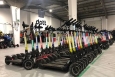
Brussels is following Paris, Madrid and Prague in the banning of shared e-scooters from 1 January 2027, citing the high number of accidents that they are involved in.
There were 666 injuries involving electric scooters in 2025, representing a rise of 26% compared to the previous year, according to a joint statement from Brussels mobility minister Elke Van den Brandt (Groen) and minister-president Boris Dilliès (MR).
Other reasons for the ban include "the growing nuisance to other road users" and the use of rental scooters "for criminal purposes", with e-scooters having been involved in 25 shootings in the capital just last year.
“The decision to exclude self-service scooters from the Brussels urban landscape is part of a clear and consistent policy,” Dilliès said.
“Often synonymous with disorder, self-service scooters are a source of nuisance, cause serious injuries, clutter the streets and are, unfortunately, increasingly being used by organised criminals. Self-service bicycles, on the other hand, remain for us an essential part of a mobility policy.”
Shared scooters have been contentious in Brussels for quite some time now, often left abandoned in piles on pavements or in ways that otherwise impede pedestrians and other road users, especially those with reduced mobility.
The ban nevertheless came as a surprise, as the capital has been implementing various measures meant to curb the nuisance in recent years.
“The risk of injury is 10 times higher compared to bicycles,” Van den Brandt said last month while advocating for mandatory helmet laws for scooter users, prior to the decision to ban them altogether.
“If the risk is one for a car, it’s nine for a bicycle and 93 for electric scooters. We also see a high proportion of head injuries because riders are thrown forwards.
"A&E staff have been sounding the alarm for some time regarding the serious injuries they are seeing linked to the rise of electric scooters. In Brussels, 71% of cyclists wear a helmet, compared to 20% of electric scooter users.”
In August 2025, Belgian traffic institute Vias noted that of the 470 accidents resulting in injury in Belgium involving an electric scooter during the first three months of the year, 127 had occurred in the Brussels region, representing almost a quarter of the national total and a 44% increase year on year.
This was despite new federal and regional rules imposed on users from 2022 - a minimum age of 16, no more than two people per scooter, and a speed limit of 20 km/h.
Brussels authorities were already very concerned about the rise in the number of accidents resulting in physical injury - from 36 in 2021 to 122 in 2022, a 230% increase.
In the same year, Saint-Pierre University Hospital produced a study on the injuries sustained by people arriving at A&E following a scooter accident, based on admissions between June 2019 and June 2020.
The study found that of the 170 patients aged over 16, the rider was in most cases not wearing a helmet and more likely to be under the influence of alcohol in the evening, and nearly one in two suffered craniofacial injuries.
The study also revealed that almost 84% of respondents who had been involved in a scooter accident were solely at fault, and that 58% of accidents occurred between 18.00 and 7.00.
Despite stricter rules for users, the situation has not improved. Nationally "the number of deaths among people travelling by electric scooter rose sharply in one year, from four to 13", Vias noted in March.
“The number of accidents resulting in injury also increased by 34% for this category of users,” the traffic institute said.
The licences granted to current operators Bolt and Dott expire at the end of 2026 and will not be renewed, nor will new operators be allowed to offer scooters for rent.
According to the ACV-CSC trade union, 60 jobs are at risk at Dott alone.
“It’s a brutal and socially irresponsible decision taken without sufficient consultation, neither with the social partners nor with employers in the sector,” said the trade union, adding that the majority of the workers affected are low-skilled, making it difficult for them to re-enter the capital’s labour market, which is already under strain.
“No real alternative has been considered, even though solutions did exist. It’s unacceptable that political decisions should have the direct effect of undermining workers who are already vulnerable.”
The union is calling for consultation and the implementation of concrete solutions aimed at preserving jobs and supporting the workers concerned.
Bolt said it was "deeply disappointed" by the decision and that it will have direct consequences on "those whose jobs depend on this service, from the teams who manage and maintain our fleet on the ground on a daily basis, right through to the wider ecosystem of local partners that this service supports".
“When scooters are the subject of public debate, whether regarding road safety or parking, private and shared scooters are almost always lumped together, even though they are fundamentally different,” the company said in a statement.
“Banning [shared scooters] will not stop people from getting around. It will drive users towards private, unregulated, untraceable and genuinely dangerous scooters, or towards more polluting modes of transport. Neither of these scenarios serves Brussels’ objectives regarding safety, congestion or the climate.”
The decision to ban scooters will not affect the provision of shared bicycles, which will continue in Brussels. The details of the reform aimed at establishing a new licensing regime for shared bicycles have yet to be finalised.
The current concession for the Villo! service expires in September 2026. To ensure continuity of service and allow Brussels residents to continue to have access to a bike-share scheme during the transition to a new model, the current operator will extend its operation until September 2028 at the latest. By this date, a new fixed-station bike-share system must be put in place.
“This decision goes beyond safety alone. It is about choosing a city with enough alternatives to get around quickly and efficiently,” Van den Brandt said of the scooter ban.
“That is why we will be giving Villo! a long-awaited update.”
Several principles have already been agreed. The network will continue to cover all of Brussels’ neighbourhoods via fixed stations, the bikes will be electric, and the organisation of the service will remain under the control of the Brussels region, which will award the contract for its operation through a public tender.
It is not just unions and the scooter companies criticising the decision. Mobility expert Dirk Lauwers (UAntwerp) told Bruzz that the Brussels government is targeting the wrong enemy.
“It’s the private scooters, which people use to speed through pedestrian zones at 50 km/h, that pose the greatest danger,” Lauwers said.
“Shared scooters are limited to 8 km/h in pedestrian zones, and to 20 km/h elsewhere, whereas you sometimes see people tearing through such pedestrian zones on a souped-up private scooter at 50 km/h. Shared scooters are much easier to manage. The government has missed an opportunity here.”
Lauwers said it would have been better to follow London’s example.
“There, private scooters have been banned from public roads for several years, while shared scooters remain permitted,” he said.
“The result: the use of shared scooters has doubled there. Admittedly, the number of accidents has also risen slightly, but the risk of an accident per user has fallen significantly.
"Shared scooters are also strictly monitored there. For example, there are providers whose scooters won’t start if two people are standing on them. So it’s getting safer there every year."