
- Daily & Weekly newsletters
- Buy & download The Bulletin
- Comment on our articles
Related articles
Recent


Popular




Mons exhibition shines a light on Belgian art and the communist utopia of the 20th century

Art has long served as a powerful medium for political expression. Offering a fresh perspective on Belgian art, a new exhibition by the city of Mons looks at the country’s communist movement in the 20th century through the prism of its artists.
Regards Pluriels: L’art belge et l’utopie communiste au XXème siècle at the Beaux-Arts Museum (CAP) proposes a chronological and thematic experience through paintings, sculpture, engraving, posters and monumental works.
Among the 60 artists on display are Frans Masereel, René Magritte, Jane Graverol, Pol Bury, Guillaume Venden Borre, Roger Somville, Jan Vanriet, Marthe Velle and Jo Dustin.

While artists’ connection to the communist movement varied, they each had some involvement, whether it was an intellectual affinity or a critical reflection on its ideals.
The aim of the exhibition is to explore the relationship between the social and political engagement of the artist and its influence on their work, explains museum director Xavier Roland.
“Social engagements are part of the history of the region of Mons, as is the case with Belgian surrealism. A tradition that has never really been explored here in Mons,” he says.
“A museum is often considered as an individualistic and elitist experience but it can open the field of debate and reflection,” adds Roland.
The Belgian communist party was active from 1921 to 1989, characterised by its division between marginality and normality, radicalism and moderation. It was in the aftermath of the Russian revolution that it took shape in the early 1920s.
If communism consistently lacked electoral strength during the 20th century, this was compensated by its influence among trade union, intellectual and artistic movements.
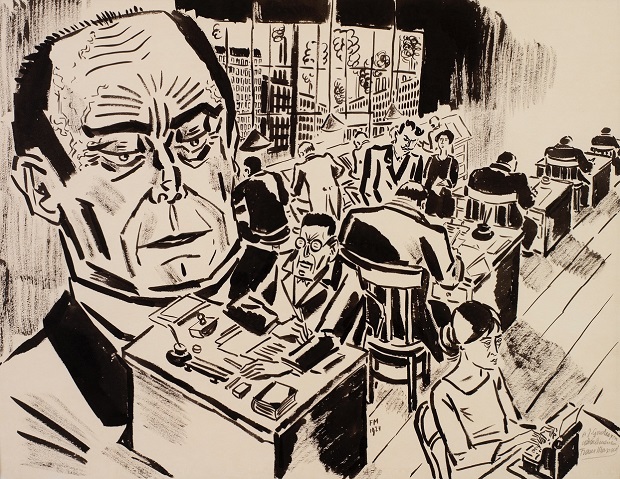
Divided into thematic sections, the first introduces the notion of the colour red in art, initiated by the Russian revolution in 1917. It inspired a number of Belgian artists, including Frans Masereel, whose engravings and drawings showed his commitment to the anti-fascist and social struggles of his age (Au bureau (1924), pictured).
This political overthrow also sparked an artistic revolution with the introduction of new creative codes during the ensuing 10 years of avant garde art. Drawings, posters and caricatures published in the communist press reveal how art became a tool for mobilising and disseminating communist ideas.
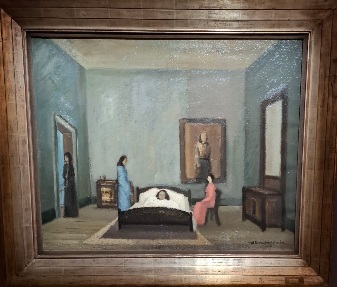
An example of a complex relationship with the communist utopia is painter War Van Overstraeten (1891-1981), whose painting La malade (pictured) is on display. Born in East Flanders to a bourgeois family, he was one of the main founders of the Belgian communist party. But in the mid-1920s he was party to many internal conflicts and dissension among the movement and personally opposed Stalin’s views and methods. It led to his rejection from the party in 1928.
For curator Paul Aron, professor of literature at the Free University of Brussels (ULB), the show is intended to be historical, political and aesthetic.
“The project matured for at least four years and was initially born following a visit to another art exhibition in Paris in 2021 by the French Communist Party,” Aron says.
Although it was never an important political player, Belgian communism played a key role in their country’s wartime resistance and enjoyed a brief golden age following the liberation of Belgium and the end of World War Two.
Even prior to the German invasion, communists opposed the country’s Rexist party, the fascist movement led by Leon Degrelle, who would become a Nazi collaborator.
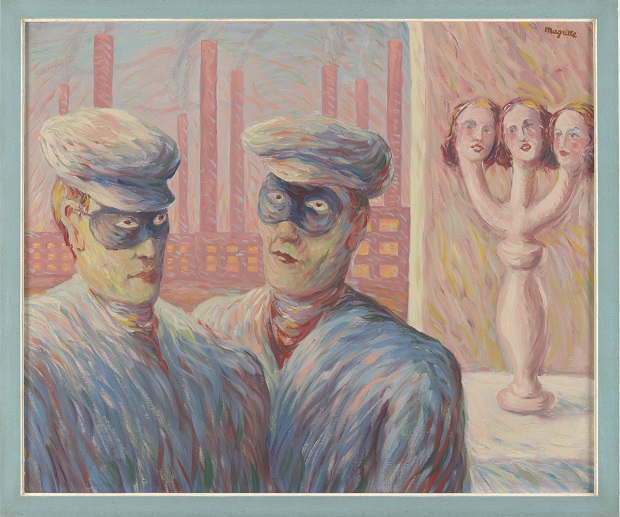
This period is illustrated by René Magritte’s work Le vrai visage de Rex, comité de vigilance des intellectuels antifascists (1936). A second work by the surrealist, L’Intelligence (1946) (pictured) exposes his own complicated relationship with the political movement. Although one of his works was exhibited in a show in support of the party, the artist did not appreciate its disapproval of surrealism.
Another section covers the duration of WW2; a difficult time for the utopian communist movement as many of its leaders in Belgium were deported or executed. Some artworks directly evoke the war and the experience in concentration camps.
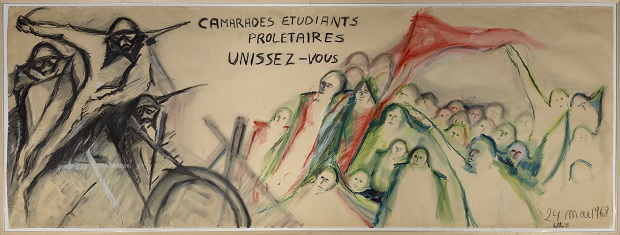
As communism waned between 1960 and 1980, the focus turned to social struggles in Belgium, while also looking beyond the country to causes around the world. This enables the museum to examine art and its relationship with contemporary issues.
The exhibition concludes that there was no unique and monolithic communist art during the past century, but on the contrary, a plurality of artistic expressions. Each artist had a contrasting and often thorny relationship with the communist utopia and therefore expressed it differently.
Regards Pluriels: L’art belge et l’utopie communiste au XXème siècle
Until 16 August
CAP/Musée des Beaux-Arts
Rue Neuve 8
Mons
Photos: (main image) Edmond Dubrunfaut, Le pays blanc ©SABAM Belgium, 2026, Collection privée; Jan Vanriet, Red Majakovski 1923, 1985, Huile sur toile, 149 x 192 cm, photo Dominique Provost ©SABAM Belgium, 2026, Collection Jan Vanriet & Semafoor; Frans Masereel, Au bureau, 1924, photo Bernard Babette - Dries Van den Brande ©SABAM Belgium, 2026, Collection privée; René Magritte, L'Intelligence, 1946, photo J. Geleyns © Succession Magritte ©SABAM Belgium, 2026, Collection Musées royaux des Beaux-Arts de Belgique (Bruxelles); Arié Mandelbaum, Camarades, étudiants, prolétaires, unissez-vous !, 1969, Photo Jean Cosyn, Collection de l’Université libre de Bruxelles