
- Daily & Weekly newsletters
- Buy & download The Bulletin
- Comment on our articles
Related articles
Recent




Popular




European Parliament commemorates International Holocaust Remembrance Day and hears from an Auschwitz survivor
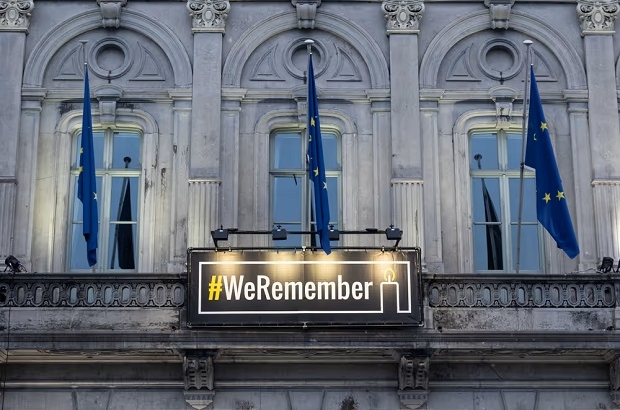
Every year on 27 January, the European Parliament comes together to mark the anniversary of the liberation of the Auschwitz-Birkenau extermination camp, as part of the International Holocaust Remembrance Day.
On this day, the Parliament honours the memory of the six million Jewish men, women and children who were murdered by the Nazi regime. It also remembers all those from the Roma and Sinti communities, and the many others who were massacred because of their faith, ethnicity, sexual orientation, disability or political views.
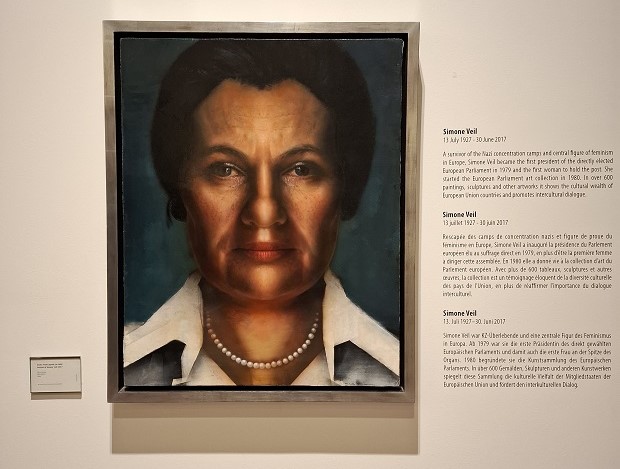
The European Parliament established the Remembrance Day in a resolution in 1995, following similar resolutions at the time on racism, xenophobia and antisemitism, and the return of plundered property to Jewish communities.
Formal ceremonies have been held by the European Parliament since 2019. Here, speakers – usually Holocaust survivors and their families – share their stories with the Parliament, and with European citizens.
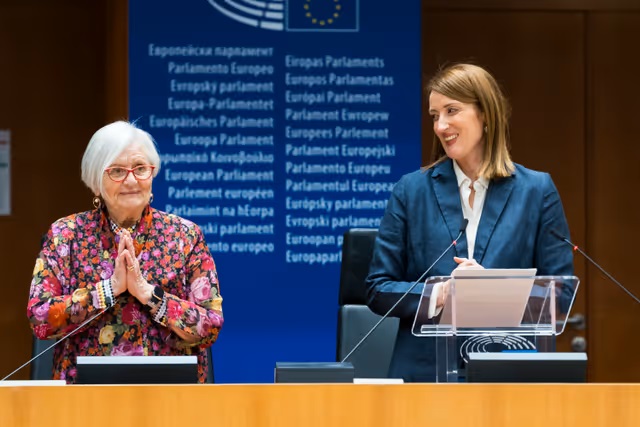
This year, Roberta Metsola, President of the Parliament, opened the ceremony and honoured the presence of Tatiana Bucci, a survivor of the Holocaust who lives in Belgium.
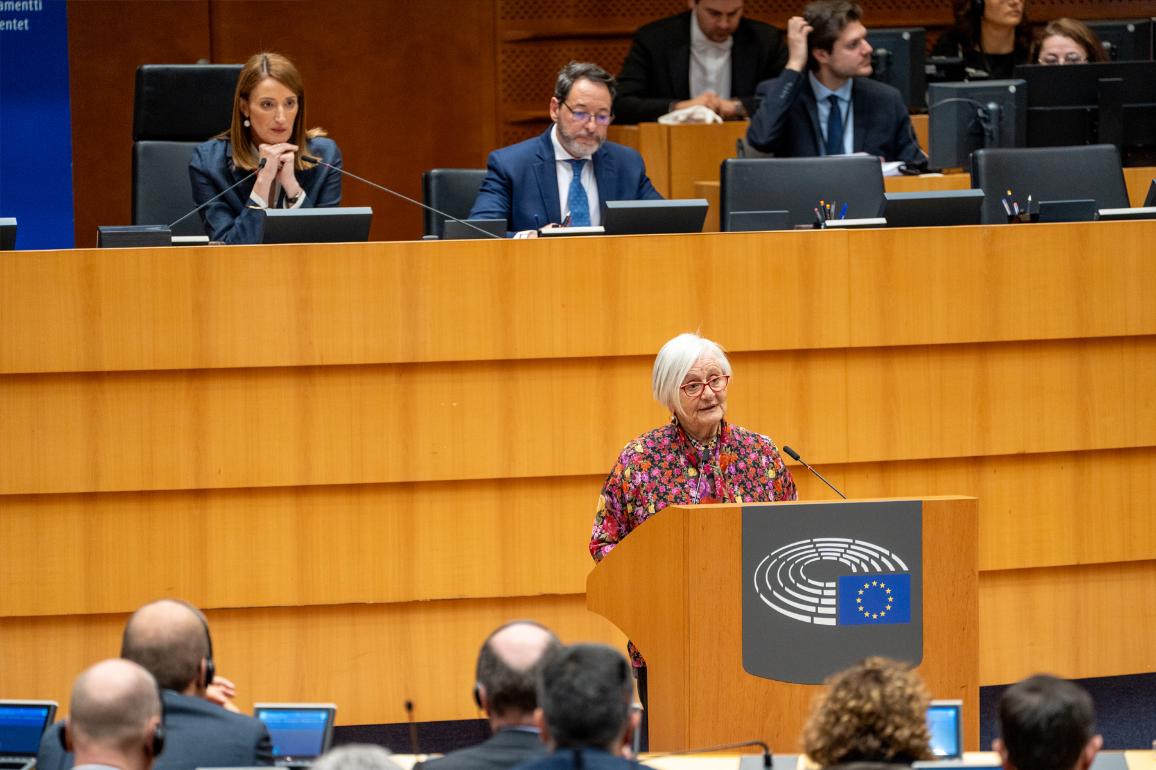
During her intervention in front of the plenary session, Bucci (pictured above) told the story of her family, her sister Andra, her mother, her aunt and her cousin Sergio, all deported to the concentration camp of Auschwitz-Birkenau in March 1944.
Tatiana Bucci was born in 1937 in Fiume, Italy (today Rijeka, Croatia); her sister Andra in 1939. Their Jewish mother Mira, whose family had fled Ukraine to find refuge in Fiume, married their father Giovanni, an Italian Catholic ship’s cook in the merchant navy.
Tatiana and Andra came into a world that was falling apart as Italy joined the war on the side of the Nazis, under the fascist regime of Mussolini. Their father was reported missing when he and his crew were taken captive and imprisoned in South Africa by British troops.
On 21 March 1944, Nazis and Italian fascists burst into their house where Tatiana, 6, and Andra, 4, were living with their mother Mira, their grandmother, as well as their aunt and cousin Sergio Di Simone from Naples. It was Sergio’s seventh birthday.
The whole family was deported to Auschwitz-Birkenau where they were split-up. During the first selection process, their elderly grandmother and aunt were directly transferred to the gas chambers to be executed.
Separated from their mother, Tatiana and Andra were mistaken for twins and survived the first selection process, along with Sergio. The three of them spent 10 months together in Birkenau with all the other children aged under 10. In the camps, children over this age were considered adolescents and had to live and work with the remaining adults.
The two sisters were spared a second time as a guard warned them to not reply if they were given the option of joining their mother. They told their cousin Sergio, but sadly he could not resist the temptation to be reunited with his mother and accepted the proposal.
Sergio, along with 19 other children, was deported to Neuengamme concentration camp near Hamburg on 29 November 1944. There, they underwent human medical experiments before being executed. Tatiana and Andra would only learn about these tragic events in the 1950s following an investigation by German journalist Günther Schwarberg.
At the end of the war, the two sisters were liberated by soviet troops before being relocated to Czechoslovakia. They were then transferred to a specialised Jewish orphanage in England.
After a long search process, the orphanage discovered that their parents were still alive. On 5 December 1946, Tatiana and Andra were officially reunited with their parents in Rome.
Tatiana remembers feeling overwhelmed that day as the whole Jewish community in Rome gathered around her, waving pictures of children still missing, asking them if they had news of the missing youngsters.
It was only much later that she learned about the raid on the Roman Ghetto which took place on 16 October 1943. Around 200 children were deported. Not a single one came back.
“When we talked about children today, specifically with everything that is happening, all these children that are leaving us, it hurts,” she said. “I would like to conclude my testimonial here by saying that I would like, for all children in the world, wherever they die, I want them to be able to have the life that I was able to have after the war,” Bucci told the European Parliament.

Following the plenary session, the parliament screened the short Italian animation La storia di Sergio (The story of Sergio). Directed by Rosalba Vitellaro, the film recounts the tragic end of Tatiana and Andra’s cousin, Sergio. It shows his deportation to Neuengamme camp along with the other children, through the eyes and research of Schwarberg and his wife, attorney Barbara Hüsing.
The remembrance day commemorations concluded with a concert by the Degenerate Music ensemble.
Photos: ©EP; portrait of Simone Veil, survivor of the Holocaust and first woman to be elected President of the European Parliament in 1979; Tatiana Bucci ©EP; film screening ©EP