
- Daily & Weekly newsletters
- Buy & download The Bulletin
- Comment on our articles
Related articles
Recent



Popular


Brussels' first permanent outdoor swimming pool could open by 2030
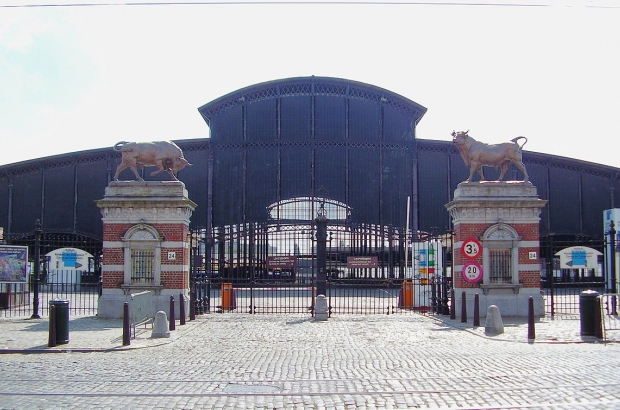
Brussels’ first permanent open-air swimming pool could open on the rooftop of the site of the former abattoir in Anderlecht by 2030.
The facilities would include an outdoor pool, a 25-metre indoor pool and a teaching pool for potentially year-round swimming.
Advocates for open-air swimming in the capital, including the Pool is Cool movement, have been fighting for years to get a permanent location after many successful but temporary pilot programmes during summer.
“We’ve been working on this since 2018, together with the Anderlecht Abattoir, and this pool will be built in a key location where there’s a great need for such infrastructure, but this is still nowhere near enough,” Pool is Cool coordinator Paul Steinbrück told Bruzz.
“Berlin has 26 swimming facilities for a population of around 3.5 million. For the more than one million people living in Brussels, a single swimming pool is a drop in the ocean.”
The contract is due to be awarded in 2028 and will be followed by at least 18 months of construction, which, if everything goes according to plan, means the swimming pool could open in 2030.
The abattoir building in Anderlecht has to first be structurally adapted to accommodate a swimming pool using support from the Flemish Community Commission.
For the next stages of the project, the Brussels government plans to rely on a yet-to-be-selected private partner which will be responsible for designing, building, financing, and then maintaining and operating the swimming pool for 30 years.
During this 30-year period, the region will pay a fee. Upon expiry of the contract, the swimming pool will become the property of the Brussels region.
This type of model is known as DBFMO, which stands for Design, Build, Finance, Maintain and Operate. Other DBFMO projects include the new Brussels Fire Brigade station at Tour & Taxis and the Kasterlinden-De Poolster campus in Berchem-Sainte-Agathe, which houses a primary and secondary school among other facilities.
But Steinbrück said the government should be cautious about such a public-private partnership.
“In the long term, it often turns out to be more expensive than if the government were to run it itself,” Steinbrück said.
“It remains a service provided by a private company seeking to make a profit. As a result, operations are often heavily optimised and costs are kept to a minimum.”
Steinbrück is also worried that profit optimisation can be particularly problematic in the case of an outdoor swimming pool, which is heavily dependent on the weather and therefore more difficult to operate profitably than an indoor pool, meaning a private operator could be tempted to open the outdoor pool less frequently than a public provider.
For this reason, Steinbrück said it was crucial for the Brussels government to set out in great detail in advance exactly what it expects from the operator, not only in terms of construction and maintenance, but also regarding opening hours, admission fees, swimming lessons, school swimming sessions and the availability of the outdoor pool.
The call for proposals for the swimming site has not yet been published, so it is not yet clear what conditions the Brussels authorities will impose on the future operator, nor which companies will compete for the contract.
Well-known swimming pool operators such as Sportoase and Lago could put themselves forward, and Lago has already indicated its interest.
“We’re awaiting the tender documents, which we expect in the coming weeks,” said Lago’s managing director Dieter Thielemans.
“We’ll certainly be submitting a bid. We currently manage about 15 facilities in Belgium. For us, Brussels is still a blind spot, while there’s a great need for swimming facilities there.”
The plans for the pool stretch as far back as to 2021, when a feasibility study was announced for an open-air pool at the abattoir site. Then in 2022, the region indicated it also wanted to build housing there.
The recently approved masterplan is intended to also revitalise the entire neighbourhood.
“Cureghem is currently one of the neighbourhoods hardest hit by metropolitan problems such as nuisance caused by drug dealing and drug use, social vulnerability and a lack of high-quality public space,” said a spokesperson from the office of Brussels state secretary Ans Persoons (Vooruit).
This is why the Brussels government wants to invest in the former abattoir site while ensuring it retains its unique character. Over the coming years, the site is set to develop into a mixed-use urban neighbourhood featuring housing, hospitality venues, community facilities and sustainable food production, along with more and better connected public spaces and green areas.
The current car park along the Quai de l'Industrie will get a cycle and pedestrian esplanade and the area around Delacroix metro station will also be developed to improve the site’s accessibility.
The existing geothermal heating network is one of the options being considered for an energy supply that could be used in future to heat buildings and swimming water.
It is not yet clear what budget the government will allocate for the project.