
- Daily & Weekly newsletters
- Buy & download The Bulletin
- Comment on our articles
Related articles
Recent



Popular


Belgian scientist Francis Halzen wins Nobel physics prize
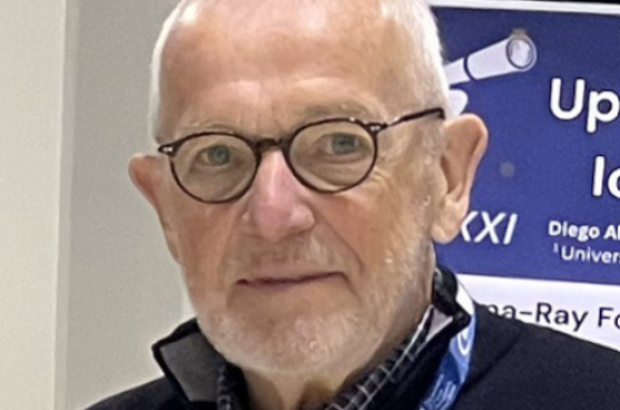
Francis Halzen, who holds a PhD in physics from the Catholic University of Louvain, has just been awarded the prestigious 2026 Nobel Prize in Physics.
Following François Englert (ULB), Halzen is the second Belgian to be honoured in this way for his work, which focused on particle physics.
“It’s a huge surprise. I certainly wasn’t expecting it,” said the 82-year-old laureate, speaking in an interview with the Nobel Foundation.
Born in Tienen in 1944, Halzen is a pioneer in the field of particle physics.
He describes himself as fascinated by the infinitely small, especially neutrinos - particles of cosmic origin that are extremely difficult to detect.
The neutrino “is the most elusive particle in the universe”, explains the Nobel Committee, and passes “through matter without being noticed”.
“In the 1980s, Francis Halzen realised that Antarctic ice could be ideal for capturing enough of these elusive neutrinos to enable researchers to learn more about their distant origins,” the committee said.
To achieve this, Halzen developed the IceCube project. It entails a huge block of ice measuring one cubic kilometre, installed beneath the ice at the South Pole, which houses a one-of-a-kind telescope.
This telescope detects neutrinos because, when they collide with ice molecules, flashes of light are produced on the thousands of optical sensors installed within the cube.
Thanks to the data gathered from the IceCube project, scientists can now study extreme cosmic phenomena such as black holes and supernovae, and gain a better understanding of the origins of the Universe.
Professor Gwenhaël Wilberts Dewasseige (UCLouvain), an astrophysicist who specialises in neutrinos, and her team of 12 researchers are contributing to the IceCube project, as well as to another neutrino detection project, KM3Net, which is located deep beneath the Mediterranean Sea.
Halzen has spent most of his career in the United States. He now teaches at the University of Wisconsin–Madison, but has always maintained close ties with UCLouvain. He has already been honoured with numerous awards and has published more than 1,000 scientific articles.
As well as being one of the most prestigious awards in the world, the Nobel Prize consists of a diploma, a gold medal and a cheque for 12 million Swedish krona, equivalent to about €1 million.