
- Daily & Weekly newsletters
- Buy & download The Bulletin
- Comment on our articles
Related articles
Recent



Popular



Riots at youth protest lead to 150 arrests
Police made 150 arrests, most of which were administrative arrests, in connection with violence and vandalism during Saturday’s protest against cuts to French-speaking education.
The Brussels public prosecutor’s office said 19 of those arrested had been remanded in custody - 11 adults and eight minors. Of those eight, three are from Brussels and the other five are from Walloon Brabant and West Flanders.
“The figures may still change, as the judicial authorities are currently continuing to work on identifying further suspects,” the public prosecutor’s office said.
“Freedom of expression and the right to peaceful protest are fundamental to our constitutional state, but the law - and, above all, the physical integrity and property of others - must be respected.”
The majority of the arrests were made by the Brussels-South police zone.
Video footage of the violence shows some perpetrators wearing masks. The public prosecutor’s office points out that it is prohibited to conceal one’s face in public and anyone who does so risks a fine of between €200 and €20,000.
The protest, which was not granted permission, involved at least 500 participants.
One major complaint from demonstrators regards the introduction of an enrolment fee for higher education. This will be raised next year from €800 to €1,100 per academic year.
“My mum is ill, so I can’t afford that,” 20-year-old ULB student Chirine told Bruzz.
“Money doesn’t grow on trees. The right to education is being eroded in this way, while a degree means everything these days. This is about democracy: soon, only the rich will be able to go to university.”
Another 20-year-old ULB student, Pauline, also described the increase in enrolment fees as “unacceptable”.
“And it doesn’t stop there: a TEC travel pass for young people is also rising from €12 to €384,” Pauline told Bruzz.
“Students don’t have that sort of money, and I live in Wallonia. How am I supposed to get home at the weekend now?”
Saturday’s protest extended beyond the issue of cuts to French-speaking education. Among the student protestors, numerous anti-fascist flags were on display and a large number of pro-Palestinian demonstrators joined the march.
They shared the feeling that their voices were not being heard, that cuts were being made without their input, and that any protests would be squashed using police violence.
Consequently, the police were the main target of a large number of slogans on Saturday and demonstrators spoke out about personal experiences with state violence.
“There’s a lot of police violence. This demonstration isn’t against the police, but the police are trying to stop us from demonstrating, even though that’s a fundamental right,” said 18-year-old UCL student Simon.
“At a certain point, you have no choice left if you want to be heard. The government, the elite: they couldn’t care less.
"The only thing that scares them and makes them listen is when people smash things up. It’s the government’s contempt that drives people to do this."
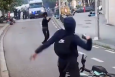
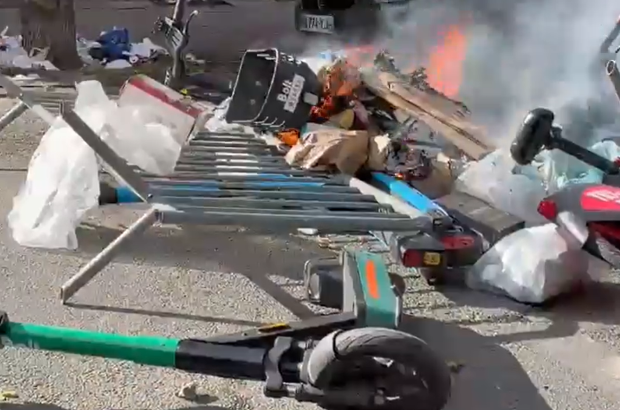
Several windows were smashed during the protest and cars were set on fire, as was a large rubbish container.
Interior minister Bernard Quintin (MR) strongly condemned the rioting, saying it meant the demonstration was no longer a protest.
“It is pure and simple violence, organised and repeated to destabilise our society,” Quintin said.
Brussels MP Mathias Vanden Borre (N-VA) agreed, adding that he is worried an overcrowded and overburdened prison system will result in many perpetrators escaping consequences.
“Our police are not a punching bag,” said Vanden Borre.
“Anyone who attacks officers, throws Molotov cocktails and vandalises public spaces must face the consequences. Underage offenders must not be allowed to get away scot-free simply because there is no space in secure youth detention centres.”
The N-VA party plans to table a resolution in the Brussels parliament that would create a regional framework for demonstrations, with clear agreements between the municipalities, the police, Brussels public transport operator Stib and other relevant stakeholders to improve preparation and cooperation during demonstrations.
Independent Brussels parliament member Sonja Hoylaerts also does not want the parents of rioters to go unpunished and advocates suspending child benefit in cases of serious juvenile delinquency.
“Parents have an important responsibility in the upbringing of their children,” Hoylaerts said.
“When minors are repeatedly involved in serious riots, we must also dare to examine [parents'] role.”
Saturday’s violence coincided with Brussels Museum Night Fever, prompting a difficult start to the popular event.
Belgian Beer World was forced to close its doors for three hours due to the unrest in the area and public transport was also temporarily suspended.
The 19th edition of the festival still attracted 14,400 visitors, clocking up about 54,000 visits to 28 participating museums, but this is fewer than last year’s 16,000 visitors.
“At a time when the cultural and heritage sector is facing various challenges, this strong turnout provides significant support for Brussels’ museums,” organisers said, noting that they were nevertheless satisfied with the turnout.
“With nearly 75% of participants aged between 16 and 35, Museum Night Fever has once again reached its target audience of those who don’t always find their way to museums of their own accord.”