- Daily & Weekly newsletters
- Buy & download The Bulletin
- Comment on our articles
Hidden treasures: 500 reasons to get out and explore this summer
When journalist and author Derek Blyth sat down with an Antwerp publisher to discuss his plan for an atypical travel guide to Brussels, he had a hard time convincing the veteran exec that he could fill an entire book with the capital’s overlooked gems.
“He wasn’t at all excited by the idea of a book on Brussels. He didn’t think it would sell in large numbers; he didn’t think I would find 500 hidden secrets,” Blyth says, sitting in the Filigranes bookshop’s cafe in Brussels, where he pitched the book to Luster CEO Mark Verhagen in the summer of 2011. “But he was prepared to take a risk, I guess.”
Five years later, The 500 Hidden Secrets of Brussels has sold more than 25,000 copies and has spawned an international series packing 16 sister titles, with Dublin and New York the most recent additions.
The stylishly designed book, which catalogues places and sights off the trampled tourist path across nine of the city’s neighbourhoods, has charmed Brusselaars and visitors alike. The success has perplexed even Blyth, the former editor-in-chief of Flanders Today. “It’s very strange; it’s just one of those things that people seem to like,” he says. “I don’t know how that happened.”
Well, for one, people love curation in this age of information overload. When picking a Japanese restaurant for dinner can be an anxiety-inducing experience – is this really the best one? – it’s a relief to have someone knowledgeable boil Brussels’ Japanese culinary scene down to just five places. Done.
Hit the streets
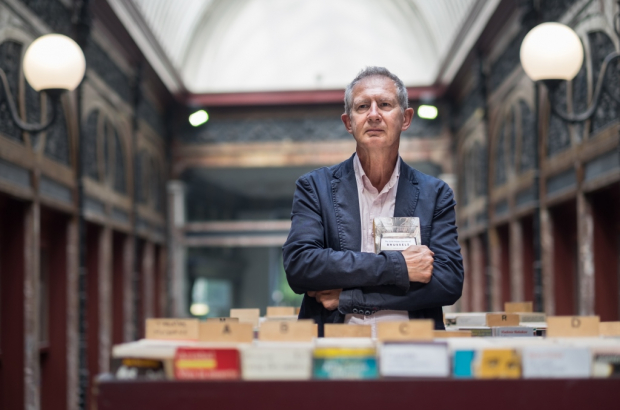
Blyth (pictured) went on to write four local successors, covering Antwerp, Ghent, the Belgian coast and Flanders Fields, and he is currently working on perhaps the most ambitious edition of them all, The 500 Hidden Secrets of Belgium, which is due to hit bookstands by the end of the year.
Although the publisher misjudged just how much the book, selected parts of which were put online last month, would resonate with readers, he was right about one thing: 500 is a lot.
Blyth thought he knew exactly which curious buildings, obscure parks and cultural hotspots he wanted to introduce readers to, thanks to his extensive knowledge of a city he’s called home for two decades. But when he sat down to actually write the entries crowding his head, he realised what was what. “I had a big panic because I was really nowhere near 500,” he says. “I might have been up to about 120, 130 places.”
To hit the targets he had pitched and identify the “five best remains of the city walls”, “five best terraces for sitting in the sun” and “five best trips on tram and bus”, he ventured into the city.
Over the next six months, he went on long walks five days a week – clocking an estimated 10 kilometres a day, hitting corners of Schaarbeek and Anderlecht he hadn’t previously visited. “I had to do research that no one else had really done, so I got to know the whole city that way,” he says.
It may have taken him more effort than he originally expected, but he did achieve the aim he ultimately had with his loving catalogue of secrets – to correct misperceptions about Brussels as a dull place. “If somebody says Brussels is boring, then you throw that book at them and say: ‘Pick 10 random places in this book and come back and say it’s boring after that.’”
Seriously boring
Blyth has been on this crusade for some time – since 2008 in fact, when, as editor of The Bulletin, he received a press release proudly announcing that users of the travel website TripAdvisor had declared the capital Europe’s most boring city.
“That made me angry in a way, because you’ve got Luxembourg, you’ve got The Hague, you’ve got these seriously boring cities, so I thought: What’s going on here?”
For a large part, the city’s maligned reputation appears to spring from the fact that the city hosts the European Union institutions, meaning most of its visitors go straight from meeting room to hotel room, he says, and don’t actually see the city.
Tourism offices also have to do better, he says, adding that he also wrote the travel guide to show officials that their leaflets and recommendations to visitors didn’t cover the full breadth of the city. Pointing to Saint-Gilles as a vibrant neighbourhood where you could easily spend a full weekend, he said: “The tourist office would never mention that; they would be too busy directing people to Manneken Pis or the Atomium.”
It’s perhaps why he has picked up the baton of sorts. Blyth, who also organises walking tours of Brussels, gives talks about the city and is working on an audio guide on the capital, is still doing what he did in that 2011 meeting at Filigranes, seated across from someone who had misgivings about a city that even he admits can be maddening at times and isn’t yet reaching its full creative potential.
“My main mission in life is to destroy the preconception that Brussels is boring – person by person,” he says. “I could do something more useful I suppose, like campaign against nuclear weapons. I don’t know, you just get these missions in life and you have to follow them through.”
The 500 Hidden Secrets series is published in English by Luster. Photo: Bartosz Brzezinski