
- Daily & Weekly newsletters
- Buy & download The Bulletin
- Comment on our articles
Team Jake: Relay marathon to raise funds for a very special care centre
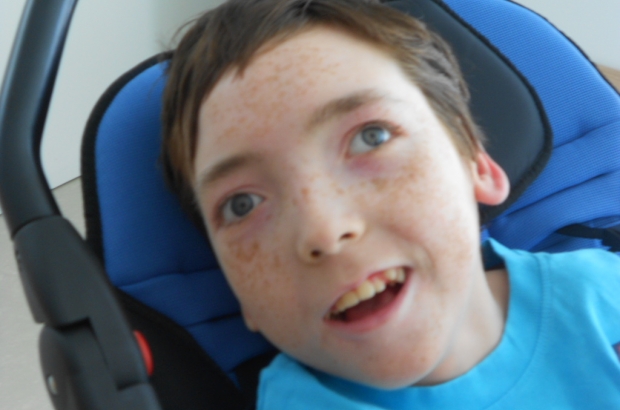
An Irish couple whose severely disabled teenage son died this summer have assembled a team of 42 friends and family to run a relay marathon next weekend for the care home near Brussels where he spent the last few years of his life.
Colm O’Brien and his wife Mairead set up the Team Jake Run for Charity fundraiser in support of De Eglantier, a day care centre for young people with severe and multiple disabilities in the rural Flemish Brabant town of Leefdaal.
There are currently 26 young people being cared for at De Eglantier, in two renovated houses. They can come to the centre until they are 25. All of them have both physical and mental disabilities, and none have mental capacities beyond the age of a one-year-old. So, among other restrictions, they cannot speak.
It is almost impossible for children with such conditions to function in Flanders’ special education system. But thanks to the Eglantier team, they get the right care at a home away from home every weekday.
For the O’Briens, De Eglantier made a world of difference. Their eldest of three sons, Jake, was born with cerebral palsy, which left him with a severe mental disability and incapable of almost any voluntary movement. After staying in various Brussels centres, Jake got a place at De Eglantier two and a half years ago, where he received care until he passed away this summer at the age of 15.
“It was life-changing for us as a family,” Colm O’Brien says of the centre. “We had, through our experience through hospitals and other care centres, always been confronted with a very cold approach to his care, which we eventually accepted - until we came to De Eglantier. We couldn't believe the love they showed the children.”
A legacy of care
The Eglantier story started in 1979, when Johan Nootens of Tervuren was searching for proper care for his daughter Floortje. “She suffered from the rare Cockayne syndrome,” he says, “which retards growth and causes abnormal sensitivity to sunlight and premature aging. We didn’t want residential care, so we looked for good alternatives. But we couldn’t find any.”
So Nootens decided to create that alternative with other parents in a similar situation. With the help of local politicians and other supporters, they turned a villa into the first small-scale Flemish day care centre for children with such severe disabilities.
Floortje died when she was six, but her legacy lives on in De Eglantier, which has since been modernised and expanded. Every time a new child joins the centre, time is spent to assess what makes them comfortable, what music stimulates them, how they communicate, then equipment is ordered, or made, tailored to them.
“We make it our point to guide the children in a very individual way,” says Ann Debontridder, who has been director of De Eglantier for the past 10 years. “They all need different care. We try to create an environment that is very homely and warm so the child feels at ease,” she says.
“A child is never on his own. A child comes with the whole family. We are very aware that having a child with those special needs asks a lot of the rest of the family. We are there to support the family as much as we can.”
Verbal communication may be impossible, but the staff at De Eglantier have various ways of interacting with the youngsters, including playing with water, giving massages, singing, dancing and playing simple games. Homemade panels of sensory objects line the wall for the children to touch as they pass, and there are specially constructed play areas.
Thanks to a collaboration with Tervuren non-profit The Healing Horse, the children can take part in hippotherapy sessions, meaning they get proper assistance to ride a horse. A speech therapist helps them develop their non-verbal communication, such as by teaching them the skills to point to something they want. Both houses also have a snoezel room, a calming space that allows a person with mental disabilities to relax and explore their senses.
Expansion
A few years ago, a house across the road from De Eglantier came on to the market. It was not visible from the road, so overgrown and abandoned was the site. Debontridder saw its potential and massive works were undertaken to convert it into Huis 20, a respite home so parents can have some much-needed rest.
Each child can stay for up to three weekends and three Saturdays a year. Families can attend other events with their other children, knowing their child is in a place where they will be fully cared for, and where the child trusts their carers, as do, importantly, the parents.
“A relaxing weekend may seem like a small thing, but it was an incredible gift for us,” Jake’s father says. “Never in the years before had we had the confidence that Jake would be happy somewhere else if we took time for ourselves. Families need that little bit of space.”
Giving something back
The government subsidies that De Eglantier receives, amounting to about €1 million a year, are not enough to cover all the costs. “We only receive subsidies for 20 children, but we have taken on board six more who really needed our help,” says Debontridder. And the school received no subsidies for renovating the second house.
The centre relies on the help of volunteers, schools, clubs, companies, hospitals, donations and fundraising events like an annual art sale. The parents also contribute, paying about €13 a day.
The O’Briens wanted to give back to De Eglantier, and are hosting teams, in Jake’s memory, to take part in the Ekiden Run, a relay marathon, to raise much-needed funds. The race takes place on Sunday 15 October in the King Baudouin Stadium, Brussels. The support has been overwhelming – they have enough runners – they just need you to sponsor them.
“We thought at first we'd organise a run as a family,” says Colm O’Brien. “Speaking to friends, they said they'd like to run too and it started to gather momentum.
“People are being very motivated. There are a lot of people who have probably never run before, probably never even walked to the shops. It is a commitment to get your runners on.”