
- Daily & Weekly newsletters
- Buy & download The Bulletin
- Comment on our articles
Related articles
Recent




Popular



The Bridge Theatre: Why Kultur Braucht Raum (Culture needs space)

Edward McMillan, the artistic director and founder of The Bridge Theatre, exposes yet another Brussels paradox and one that is stunting cultural life in the capital. Although the city abounds with performance spaces, organisations constantly struggle to find suitable and available venues due to three factors: the inefficient use of space; a large, unusable building stock; and spaces of the wrong size.
“Kultur braucht Raum. Culture needs space.” This is the slogan of the current publicity campaign of the Salzburger Festspiele that I experienced this summer.
Culture needs space. This simple three-word phrase evokes so much. It reminds us that without a stage, there is no performance. It reminds us that without a place for an audience to sit, there is no audience. But it alludes to something else. A theatre is so much more than just the public-facing foyer and auditorium. It is the dressing rooms, the rehearsal rooms, the storage rooms, the workshops, the offices. To get an idea of the scale of the non-public part of a theatre, I encourage you to take a tour of Brussels’ La Monnaie opera house.
Space also creates opportunity. It enables performances, rehearsals, classes, encounters, experimentations. The more space that is available, the more opportunity there is for activities that add value to society.
The Brussels paradox: There are approximately 220 theatre spaces in our city of 1.2 million. That’s one for every 5,500 inhabitants, which is the highest in Europe, with Prague in second place (1/12,500 inhabitants) and Paris in third (1/16,000).
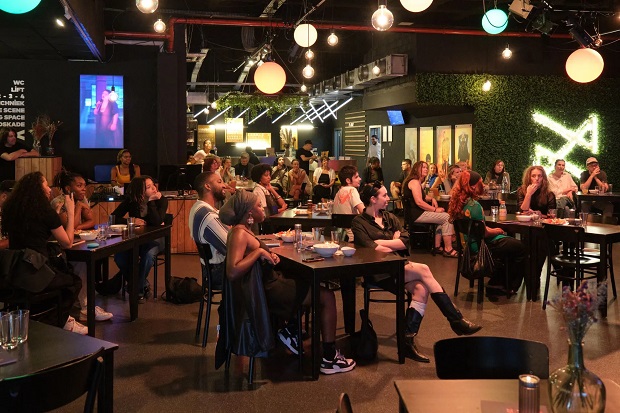
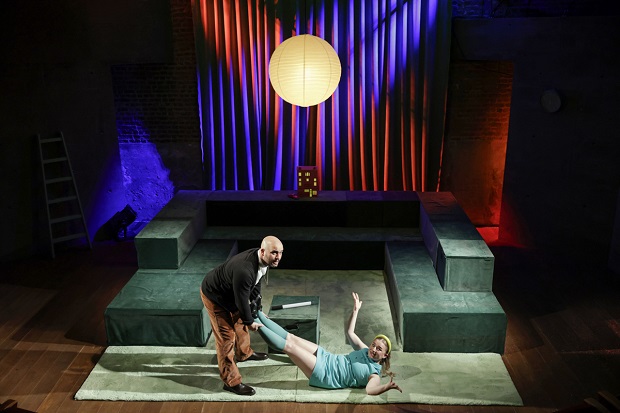
There are some fantastically well-equipped, purpose-built venues here such as Zinnema in Anderlecht (pictured above), but many venues have been born out of an improvised need to develop a space. Le Theatre du Public in Saint-Josse-ten-Noode is the most successful example: an old brewery that has slowly expanded over 30 years to create a three-venue theatre, complete with restaurant and bookshop.
And yet, despite this abnormally high concentration of performing arts spaces, it is difficult to find suitable and available performance spaces to host new productions by The Bridge Theatre. We are not alone in this struggle. From the established amateur choir I sing in, to active community theatre groups, to stand-up comedians and musicians, this experience is replicated across different fields at both professional and amateur levels.
But the demand exists, as is clear from the requests we get to rent our small Studio space in Saint-Gilles, most of which we cannot fulfil. The result of the apparent lack of space is that Brusselers miss out. Organisations provide fewer opportunities for locals to get active in the performing arts, visiting artists are less likely to perform here, The Bridge Theatre is limited to only one or two productions a year.
Why do we have another complex Brussels paradox on our hands? Here are three things that I have observed along the years.
1. Inefficient use of space
Before we moved into our Saint-Gilles Studio in 2024, I was forced to negotiate with hotels and offices, and use cold, disused buildings for our rehearsals and workshops. Rehearsal spaces do exist, of course, notably the Gosset Building in Molenbeek, as well as inside most of the producing houses of the city, but the majority are either permanently for specific companies or are accessible only to artists for residencies. But I commonly see groups using performance spaces as rehearsal spaces. No matter whether this is a cause or an effect of the lack of rehearsal spaces, it results in performance spaces being blocked from being used for their primary purpose.
2. A large, unusable building stock
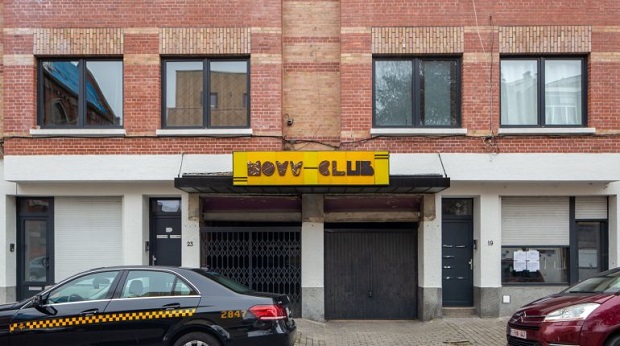
The lack of suitable spaces is also connected to the lack of adequate buildings in Brussels: 84% of property in the city was built before 1962 and only 7% of buildings were constructed after 1981. Many buildings are simply unusable and renovating them to modern standards is either too expensive or simply physically impossible. In our hunt for a suitable space, I came across treasure troves and oddities that have been abandoned for decades. Aegidium and Movy Club (pictured above) – both in Saint-Gilles and both empty for decades, although the latter is currently undergoing renovation. But others, including the former Bpost building off Flagey, have been empty for the same five years that we have been searching for such a space. Brussels has over six million square metres of unused space, what the nonprofit urban organisation Communa calls the Twentieth Commune.
Communa was a pioneer in the temporary occupation industry that now dominates the small-scale socio-cultural world of Brussels. These spaces – a response to the high rate of building inoccupancy and the slow permit system – have enabled us to do many activities that would have been otherwise impossible. But temporary occupations are not a perfect answer: these are old, sometimes completely gutted buildings, often with no heating and temporary electric and water facilities. They are a stop-gap measure. Certainly better than nothing, but their presence makes you feel very viscerally the decline of Western Europe.
3. Spaces of the wrong size
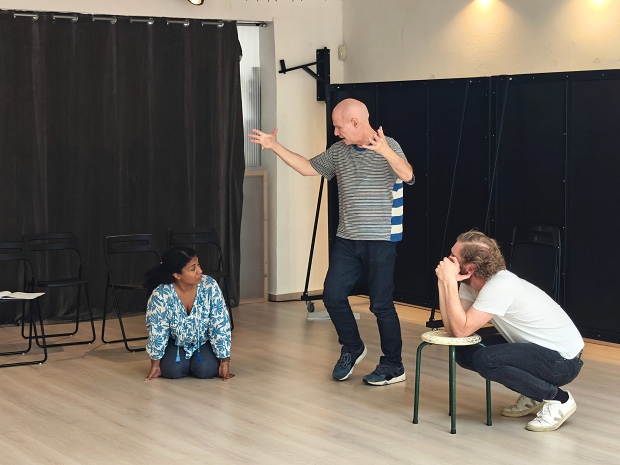
Brussels has some large venues such as Cirque Royale near Madou (2,000 seats) or Novum near Merode (1,500). It also has a plethora of smaller spaces, including La maison qui chante, where we stage our forthcoming production of Copenhagen (15 October to 6 November, pictured above). Some 50% of theatres have only 120 or fewer seats. We are lacking mid-sized spaces seating 300-500, which account for only 5% of all cultural spaces in Brussels. Smaller than this and recouping costs becomes increasingly difficult; larger than this and the rent becomes so expensive that only players with the ability to attract such a large crowd for one performance can afford it.
Unfortunately, I see a trend towards more and more micro-spaces, hosting 100 or less, which makes producing a live show financially impossible.
These three things – inefficient use of space, a large, unusable building stock and spaces of the wrong size all contribute significantly to the Brussels paradox of simultaneously being amply filled with performance spaces while organisations are not being able to find suitable and available venues.
And yet, precisely because of the high concentration of venues, it is assumed that the infrastructure needs of culture are met. I can tell you from five years of pushing the boundaries to produce theatre in this city that they are not. Perhaps it is time for Brussels to take a leaf out of Salzburg’s book and give culture the space it so desperately needs.
Photos: (main image) The Bridge Theatre - Tick Tick Boom Audience; ©Zinnema; Bridge Theatre: Radiant Vermin production; Movy Club ©Séverin Malaud; Bridge Theatre 'Copenhagen' rehearsal; ©Visitbrussels