
- Daily & Weekly newsletters
- Buy & download The Bulletin
- Comment on our articles
Related articles
Recent


Popular




Still sparkling! Belgian crystal glass manufacturer Val Saint Lambert celebrates bicentenary in style

A rare survivor of Belgium’s industrial golden age, world-famous glassware manufacturer Val Saint Lambert is marking its bicentenary with an ambitious programme of events.
The festivities at its historic site in Seraing, near Liège, continue until 6 December, centred on an illuminating exhibition and video-mapping experience under the title Living Crystal.

Meanwhile, exhibitions dedicated to the brand’s brilliant glassware open shortly in Charleroi and at the Brussels Design Museum, focusing respectively on elegant Art Deco and the latter half of the 20th century.
With a history that is older than the country of Belgium itself, the story of Val Saint Lambert is a fascinating testimony to the region’s former industrial prowess, artisan craftmanship and survival despite economic hardship.
If the crystal and glassware manufacturer boasts a 200-year history, its abbey site dates from 1202 when a community of Cistercian monks created a walled medieval settlement overlooking the River Meuse.

Over the centuries, the site was slowly transformed with a major renovation in the 18th century resulting in a large classical building housing the abbot’s residence. But the French Revolution dissolved the community along with other religious orders across the country.
New life was breathed into the site when a glass factory was established by two French engineers, Auguste Lelièvre and François Kemlin. They took advantage of its strategic location to expand during the industrial boom of the 19th century, thanks to surrounding collieries that fuelled the furnaces, a constant water supply from the adjacent river and access to a rapidly growing rail network.

The bicentenary immersive exhibition Living Crystal: 200 years of light, creation and excellence traces not only the story of Val Saint Lambert but the history of glassmaking from its origins in Mesopotamia to its role as a symbol of power and wealth. Some of the most atmospheric displays are presented in the basement of the museum: a succession of dimmed grotto-like spaces revealing the various techniques and materials for fashioning glass, as well as brilliant displays that let the pieces shine.
The factory reached the pinnacle of its production just before World War One when a 5,000-strong workforce made some 125,000 crystal objects a day. It was more than an industrial hub, the site was a living and working community with schools, stores and entertainment.

From the living rooms of Belgian households to royal residences around the world, Val Saint Lambert crystalware became revered for its purity and exceptional brilliance. It was the secret ingredient lead that created light-reflecting crystal.
The exhibition showcases some of the illustrious artists whose designs elevated the brand, including The Owl Vase, a 1925 work attributed to Léon Ledru or Jospeh Simon that adorned the famous Paris International Decorative Arts Exhibition, which launched the Art Deco movement.

Glasses, vases, carafes, ashtrays, paperweights, lampshades, bowls and ornate chandeliers, Val Saint-Lambert made it all. It also spearheaded stylish trends from Art Nouveau through to Art Deco and sleeker contemporary styles. Original one-off pieces are also on display, such as rarely seen prestigious sporting trophies.
Depression in the 1930s, followed by World War Two, heralded a downturn in sales and the company inevitably declined, although it continued to produce selected lines of crystalware.

In addition to the company’s own collections there are loans such as The Bell (1989) by Leo Copers, created for the Centraal Museum in Utrecht, which is located at the entrance to the museum.
On an upper floor, a dazzling series of large-scale contemporary installations by nonprofit Spray Can Arts illustrate precision-cut crystal’s unique qualities of transparency and light and ability to radiate colour effects.
Val Saint Lambert became a state company in 1971 before returning to private ownership in 1987, followed by periods of restructuration and social unrest. Since 2018, Belgian businessman George Forrest is the majority stakeholder. Today, the business has been transformed into a nonprofit that preserves the artisan craft. It employs 15 people and produces quality tableware as well as unique pieces and modern decorative items.

In a nearby old abbey building, the Living Crystal: Immersive Experience awaits visitors in the former monks’ dormitory. Under its lofty eaves, this 360° video mapping show by internationally-renowned Belgian artistic entrepreneur Luc Petit and Charleroi creative studio Dirty Monitor.
Recounting two centuries of history, the 25-minute HD spectacle highlights innovation, the generations of families employed at the factory and the global journey of many of its creations. Inspired by the glass blowers who kept the company alive, this an emotional and sensory homage.
If it was a technically demanding show that had to be painstakingly tailored to the heritage site, the visually exciting subject matter was a constant source of inspiration, says Orphée Cataldo, co-founder of Dirty Monitor.

The sound and light show continues until 21 June, while a third key element to the bicentenary programme at the site begins in the autumn: Lumina Crystallis is an original creation by Luc Petit featuring opera singers and circus artists.
Other activities at the abbey are also planned throughout the year, from contemporary art and film to culinary arts and family-friendly events.
Glass workshop demonstrations
Entrance to the exhibition includes a free glassblowing demonstration, a rare opportunity to discover this living craft.
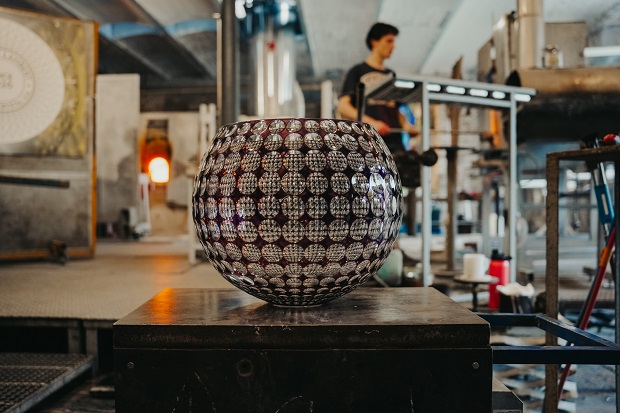
The workshop is equipped with red-hot furnaces whose blistering heat enable the glass creations to be shaped and formed. Young artisan glass blowers attach bulbs of glass to the end of a blowpipe, insert it repeatedly into the kiln, blow intermittently into the rod and slowly mould the glowing shapes.
It is mesmerising to watch as they manipulate the molten glass with the help of a multitude of specialised tools. Once the object is shaped, it disappears into a cooling oven.
Other highlights of the bicentenary programme
Two major upcoming exhibitions highlight Val Saint Lambert’s 20th century designs and evolving techniques.

Charleroi Glass Museum presents the exhibition Art Deco and Modernism at Val Saint-Lambert (1925-1939) from 18 April to September 27 at the Charleroi Museum of Fine Arts.
Meanwhile, Val Saint-Lambert & Design at the Design Museum Brussels from 24 April to 25 October is dedicated to the creative output of Val Saint Lambert from the 1958 World’s Fair to the early 2000s.
Val Saint Lambert bicentenary
Until 6 December
Site du Val Saint Lambert
Esplanade du Val 1
Seraing (Liège)
Photos: © Bicentenaire Val Saint Lambert ©Maeoka.be; view of the show ©Maeoka.be; View of the show ©Maeoka.be; immersive experience ©Maeoka.be; Lumina Crystallis ©Luc Petit; glass blowing workshop ©Maeoka.be; Design Museum Brussels exhibition ©Val Saint Lambert