
- Daily & Weekly newsletters
- Buy & download The Bulletin
- Comment on our articles
Related articles
Recent


Popular


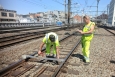


Rail unions take legal action after further strike notice is refused

Belgium’s railway unions have had a request for three more days of strike action in February refused.
After a week-long SNCB strike last week, unions wanted to strike on 5, 10 and 12 February but HR Rail, the new personnel department of railway company SNCB and rail infrastructure manager Infrabel, has rejected the strike notice.
The railway unions are taking their case to the Council of State, saying the refusal constitutes an infringement of the right to strike.
In the meantime, the joint railway workers’ union front has decided to suspend all participation in national and regional joint negotiating committees and is calling on all its representatives to systematically boycott meetings from today onwards.
“The serious obstruction of our right to strike that we are experiencing marks a definitive breakdown in trust,” the joint union front said.
Belgium has experienced 30 days of railway strike action in the space of a year - and the heads of SNCB and Infrabel have denounced the repeated actions that are paralysing the railways.
Workers are striking over austerity measures that they say make an already short-staffed sector even less attractive.
Among other things, these measures include the elimination of positions for life - or appointments - which unions say were negotiated decades ago as a compromise that offered job stability in lieu of higher wages.
SNCB and Infabel management have called on the unions to sit down at the negotiating table to hammer out a major social pact and work on making the railway profession more attractive, but unions are unwilling to negotiate after their strike notices were rejected.
“We reject this sham of social democracy as long as our constitutional right to strike is being flouted,” the unions said in a statement.
“We refuse to enter into discussions with a management that seeks to muzzle us through legal proceedings.”
Benoît Gilson, chief executive of Infrabel, said this latest strike notice did not meet the required conditions, namely prior consultation and an attempt at dialogue.
“Around 15% of workers were on strike [last week], which means that more than 85% of railway workers are actually working and keeping the trains running,” Gilson said on La Première radio, praising those who did not participate in the action.
“It takes courage to say: I am working during a strike to maintain public services, because people need them.”
SNCB director Sophie Dutordoir echoed the condemnation of the strike, saying "the limits of what is reasonable have been exceeded" and that the strikes were "political".
“I do not underestimate the changes for my employees, but what is happening today is really no longer reasonable,” said Dutordoir.
“These are not only detrimental to passengers, but also to the government and the railway company due to damage to their image and financial losses.”
The railway unions are mobilising to protest against the overall consequences of planned rail liberalisation by 2032 and the associated measures, especially a change in the status of railway workers.
The vast majority (90%) of railway workers today are classified as civil servants, but the government plans to switch them to contract workers, which is considered more precarious.
“I dare to believe that we have many other ways of attracting people than simply offering a status, and I don’t think that status is the main criterion for joining a company such as ours,” Infrabel’s Gilson said.
“We have a very attractive social mission, we have very attractive jobs, we have very attractive career plans. We are a social ladder because we train people a lot and we manage them to help them progress.”
Gilson said that about 15% of Infrabel’s current staff were contract workers, and SNCB’s Dutordoir told VRT that "we are currently the only railway company in Europe that does not yet recruit contract workers".
Mobility minister Jean-Luc Crucke (Les Engagés) reached a preliminary agreement with the trade unions twice last year, but Gilson said union members did not follow the agreement.
Now Crucke has also suspended consultations with the trade unions and had his draft bill approved by the Council of Ministers.
The railway sector is not the only one to be affected by the year’s worth of strikes. In several mainline railway stations, retailers have described the frequent strike action as disastrous for their own businesses.
at Charleroi station, retailers described the situation as catastrophic.
The Sweetie Bar sandwich shop told RTBF that it’s lost a third of its turnover due to the lack of customers this week.
“There's no one here. Normally, at five in the morning, there are lots of people, but here, we're all alone,” a sandwich shop employee at Charleroi-Central station told RTBF.
“People who come by train are our core customer base,” said a shop assistant at the Mons railway station branch of supermarket Monoprix.
“For us, it's obviously a big blow, even for our turnover. With losses like this, it's difficult to estimate how financially stable we'll be over the course of a year.”