

- Daily & Weekly newsletters
- Buy & download The Bulletin
- Comment on our articles
New guide makes Bruges accessible to disabled visitors
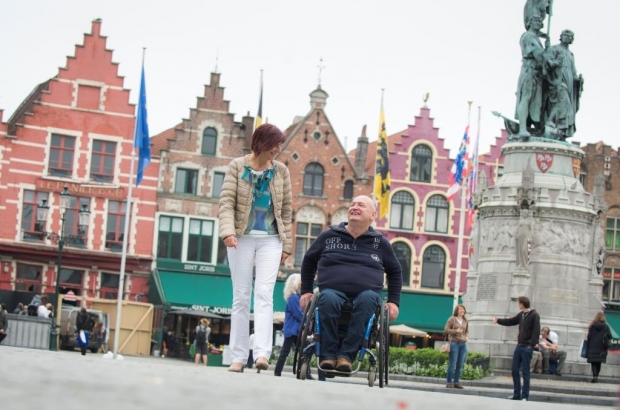
One of Belgium’s most popular tourist destinations is now even more visitor-friendly, with the publication of a new brochure aimed at disabled travellers. For the first time, Bruges visitors with reduced mobility, a visual or hearing impairment or a learning disability have a handy tool that gathers different kinds of accessibility information in one place.
The brochure combines a self-guided heritage tour through the historic city centre with a comprehensive guide to attractions, public restrooms, hotels and restaurants along and near the route.
The listings are keyed with symbols that indicate whether a location is wheelchair accessible, for instance, or has accessible toilets. Other symbols indicate whether attractions are adapted for visitors with visual or hearing impairments.
“In the past, we concentrated on guides for certain kinds of tourist information, such as hotels or restaurants,” explains Bruno Paternoster of tourism agency Visit Flanders. “Then we realised that a person with a disability needs to have access to the whole tourism chain. Every element in a journey should be accessible.”
Using the map and guide, a person with impaired mobility or other disability can enjoy the same tourist experience in Bruges as everyone else. The heritage route includes all the major sights, from the begijnhof to the belfort. The brochure is available in English as well as Dutch.
Bruges is the latest local travel hotspot to receive an accessibility makeover, thanks to a joint effort by the city, Visit Flanders and Inter, the Flemish agency for accessibility. The first accessibility study and guide were completed in 2013 for Flanders Fields and the Westhoek, followed by the coastal cities in 2015. (Those guides are also available in both Dutch and English.)
What’s different about the guide for Bruges is the addition of the heritage route linking the individual listings. The route was tested prior to publication, with the aid of a wheelchair user, a blind person and an elderly pedestrian. As a result of their feedback, some adaptations were made along the route.
Paternoster hopes that the guide will be an example for Flanders’ other art cities: Antwerp, Ghent, Mechelen and Leuven. “They are the first places that people will visit – especially international travellers,” he says.
The City of Ghent is currently working on a heritage route with On Wheels, creators of a mobile app for wheelchair users.
Photo courtesy Visit Flanders





Comments
Nice step this should be done in every part of the world to make it easier for people with reduced mobility. While exploring internet I came across few sites like having so many useful devices like power chairs, wheelchairs , pride scooters and so much to help people make their life easier. Even nowadays There are chairs designed especially for patients in nursing homes; chairs that can be operated by programmable joysticks, head controls, or are voice activated; and chairs for indoor use only. No matter what your special needs are, you can find a chair that is that is right for you.