
- Daily & Weekly newsletters
- Buy & download The Bulletin
- Comment on our articles
Related articles
Recent


Popular


More than a uniform: Olympic fashion as a cultural symbol and what it says about competitors, including Team Belgium
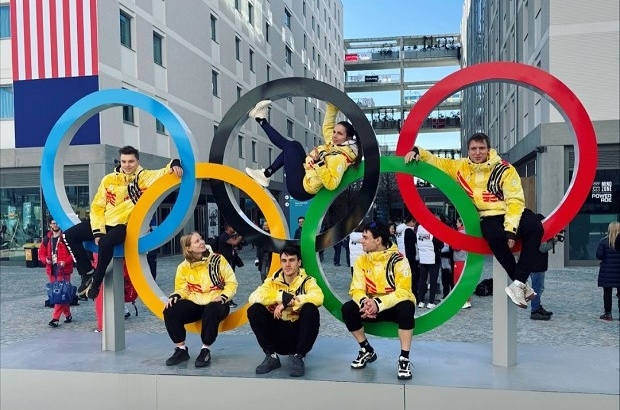
The Olympic Winter Games in Italy have officially begun, not only as a venue for athletic excellence, but also as a stage where fashion and culture converge.
Even before the games officially kicked off on 6 February, the event was already buzzing on social media. Not because of individual athletes or sports-related themes, but due to the Olympic uniforms which are revealed days or even weeks in advance.
While public discourse was heating up over which team presents the most creative design, which countries collaborated with which brands, and which uniforms will go down as disappointments in the history of winter Olympic fashion, style magazines and audiences were already crowning their unofficial winners.
Fashion and cultural symbolism in the Olympics
Olympic kits are far more than a practical means of identifying which athlete represents which country. Clothing, materials and colour schemes are carefully selected to symbolise the values and cultural heritage of each nation — sometimes explicitly, sometimes subtly.
A collective sense of identity is created with the dress code, one that spectators at home can identify with. At the same time, cultural symbolism is projected onto a global stage through design and materials, ultimately made visible to millions around the world and inevitably opened up to judgement.
Designers must, however, adhere to strict regulations set by the International Olympic Committee (IOC), which prohibit political, religious or racial propaganda in Olympic outfits.
Standout fashion pieces at the games

One of the first fashion moments to spark public attention was the uniform designed by Italian-Haitian designer Stella Jean for Haiti’s skiers Richardson Viano (23) and Stevenson Savart (25). The Caribbean nation’s delegation is one of the smallest at the Games.
After discovering that a design she had worked on for a year had been rejected, Jean hand-painted a new set within a few days. The original design featured an image of Haiti’s founding father, which was deemed a violation of IOC rules.
What remained was Toussaint’s red horse, a symbol of pride, perseverance and resistance, representing an homage to Haiti’s history. The colour palette references the Haitian flag, while the headpiece, reminiscent of a turban, stands as a fashion statement in its own right, drawing on historical influences.
Jean herself writes: “These uniforms are not an exercise in style. They are an act of responsibility. Every detail is intentional. Every centimeter of fabric carries the duty to tell a story - and the will to endure. […] What you see is not decoration. It is visibility as a form of survival.”
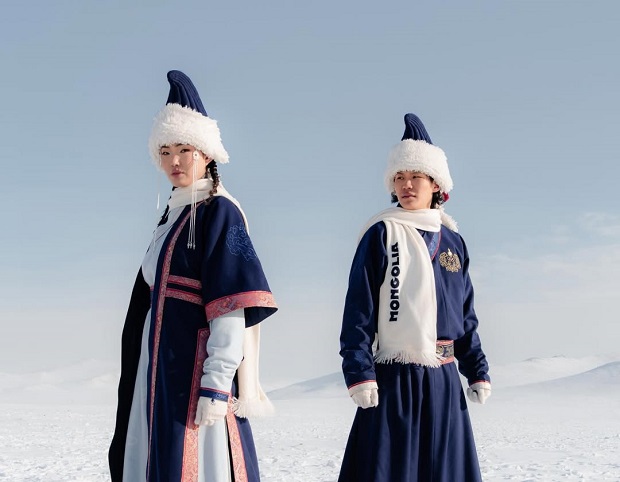
Another highly anticipated uniform belongs to the Mongolian delegation, created in collaboration with the brand Goyol Cashmere. Inspired by the Great Mongol Empire of the 13th to 15th centuries, the concept emphasises functionality, warmth and unity. At its core is the use of Mongolian cashmere, a material deeply rooted in nomadic history and essential for surviving harsh winters.
The brand explains that the designs reflect “the resilience, wisdom, and warrior spirit forged over thousands of years by Mongolians who have endured the eternal winters of the Central Asian highlands.”
The country’s three skiers Ariunbat Altanzul (20), Achbadrakh Batmunkh (31) and Ariuntungalag Enkhbayar (29) are competing for Mongolia’s first-ever Winter Olympic medal.

After nearly 60 years, Italian fashion house Moncler has returned as an Olympic sponsor, outfitting the Brazilian team with a performance-driven, nationality-centred design. In collaboration with renowned Brazilian designer Oskar Metsavaht, the collection highlights the country’s national flag combined with alpine functionality.
The 15-member team competes in bobsleigh, snowboarding, skiing and skeleton; continuing to chase the country’s first-ever Winter Olympic medal.
Belgium’s Olympic fashion statement

While Belgium has not featured prominently in most fashion rankings, its uniforms nonetheless convey strong cultural symbolism. The team is outfitted by manufacturer Peak Sport in the national colours of yellow, black and red. The symbolic motif “The Embrace”, consisting of four lines representing collaboration and unity under the slogan “one team, one dream”, was already part of the Paris 2024 design. For the Winter Games, the concept has been adapted with elements representing snow and ice.
Jean-Michel Saive, chairman of the Belgian Olympic and Interfederal Committee (BOIC), explains that “continuity allows Team Belgium to maintain its identity, while also offering a fresh, wintery look specifically for the Winter Games.”
Team Belgium: The Olympic line-up
For 2026, Belgium’s delegation is larger than ever before, with 30 athletes consisting of 16 women and 14 men. They compete across nine disciplines: biathlon, bobsleigh, figure skating, speed skating, short track, skeleton, alpine skiing, ski mountaineering and snowboarding.
Belgium first competed at the Winter Games in Chamonix in 1924 and is not traditionally known as a winter sports nation. However, the team delivered notable performances at the 2022 Games in Beijing and hopes to build on that momentum.
Speed skater Bart Swings (34) from Leuven won gold in the mass start event in Beijing, while Hanne Desmet (29) from Antwerp secured bronze in the women’s 1,000m short track.
Figure skaters Loena Hendrickx (26) and Nina Pinzarrone (19) are among Belgium’s strongest medal hopes this year. Hendrickx brings Olympic experience from the 2018 and 2022 Games, while Pinzarrone makes her Olympic debut.

Skeleton athlete Kim Meylemans (29), pictured above, also brings experience, having finished first overall in the 2025/26 Skeleton World Cup. In alpine skiing, medal hopes rest on Armand Marchant (28) and Sam Maes (27).
Identical to the financial rewards awarded at the Paris 2024 Olympic and Paralympic Summer Games, a gold medal at the Italian host city is rewarded with €50,000, a silver medal with €30,000, and a bronze medal with €20,000.
The games run until 22 February in Northern Italy.
Photos: (main image) ©Team Belgium; Team Haiti ©Stella Jean; Team Mongolia ©Goyol Cashmere; Team Brazil ©Moncler; Team Belgium; Kim Meylemans ©Team Belgium