
- Daily & Weekly newsletters
- Buy & download The Bulletin
- Comment on our articles
Related articles
Recent




Popular



Migration crisis: Brussels expected to absorb consequences of funding cuts, critics say
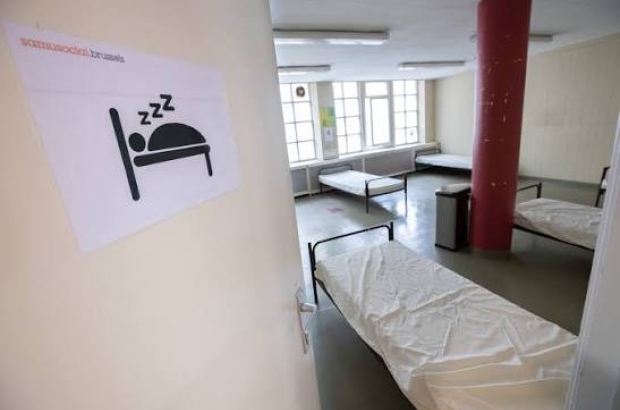
The federal government is proposing significant cuts to funding for refugee accommodation centres in Brussels, which critics say will worsen the already serious reception crisis in the country that is primarily affecting the capital.
Brussels minister Dirk De Smedt (Anders), who is responsible for homeless shelters, sharply criticised proposed cuts from federal migration minister Anneleen Van Bossuyt (N-VA).
“There is a real problem of social disruption caused by migration,” he said.
“Van Bossuyt can no longer claim today that she wants to solve this, and we must no longer allow her the leeway to keep making that claim time and again.”
Van Bossuyt (N-VA) has been funding 1,000 emergency accommodation places instead of 2,000 since 1 September under the so-called Brussels Deal, which was established in 2022 to tackle the asylum crisis that is concentrated in the capital.
Van Bossuyt justified the decision by pointing to the 1,000 people still on Fedasil’s waiting list, noting that this is down from 3,000 when she took office.
But critics counter that the decline is merely a consequence of the stricter asylum policy, which is now leaving many asylum seekers on the streets and inevitably in Brussels homeless shelters.
The Brussels government is still negotiating with the federal government over the €43 million that has so far been allocated to the capital under the Brussels Deal, which De Smedt said Van Bossuyt now wants to reduce to €19 million.
Changes to migration policy are also having consequences on the worsening situation.
When refugees are granted residence status, they must find accommodation and work as quickly as possible. Previously, support for that was provided by Fedasil and recognised refugees were able to stay in reception centres for four months.
“Now, the minister has ordered that they be evicted after two months. These people will now end up in homeless shelters or with the CPASs (social welfare centres),” De Smedt said.
“I’m happy to discuss phasing out the Brussels Deal, but first I want to know what will happen to these people.
"If they are no longer with Fedasil but end up on the streets, in our homeless shelters or with a Brussels CPAS, we haven’t phased anything out. We’ve simply shifted the problem elsewhere."
De Smedt put forward his own proposal based on a series of statistics, including that of all the people in Brussels’ emergency accommodation centres (a total of 2,855 places), 32% have submitted an asylum application. A further 23% are people who have no right of residence and therefore cannot remain in Belgium.
“Van Bossuyt can boast about her reduced waiting lists, but look at the figures: 55% of those accommodated in our emergency shelters fall under her remit,” said De Smedt.
“The federal government is proposing basic funding, followed by buffer places in Brussels should the Fedasil network become saturated. In other words: they want to buy places in Brussels’ homeless shelters for when the need arises.”
By cutting reception places, De Smedt said, Van Bossuyt is increasing the pressure on Brussels to absorb the consequences of Belgium’s asylum crisis.
De Smedt is not the only one sounding the alarm about overflowing homeless shelters. Samusocial, an organisation that works with the homeless, said it had to turn away 244 families seeking shelter in July alone.
The Brussels Refugee Medical Point, a Red Cross medical centre offering free primary care, carried out 39,259 medical interventions in the last quarter of 2025.
The city’s CPASs are also worried about an increase in pressure on their already limited resources.
De Smedt said he proposed to Fedasil and minister Van Bossuyt that, from this year onwards, 1,000 return programmes be launched annually.
“People entitled to asylum must be granted asylum, but for those with no prospect of residence, there must be an effective return policy,” said De Smedt.
“By 2029, we want to scale this up to 5,000 programmes per year. We have well-functioning projects in Brussels, in collaboration with the CPASs, where solutions ranging from regularisation to return are explored with undocumented migrants.
"The Brussels CPAS has a project in which 500 people were identified to enter a programme aimed at finding solutions. About 100 of them actually entered such a programme."
But the federal government wants to limit return programmes to 100 per year, according to De Smedt.
“Scaling up those numbers costs too much, and they simply have to make savings,” De Smedt said.
“Of course it isn’t free, but keeping those people here isn’t free either. It’s just that this isn’t a problem for Van Bossuyt, because she isn’t the one footing the bill.”