
- Daily & Weekly newsletters
- Buy & download The Bulletin
- Comment on our articles
First phase of terrorist attack investigation complete
The parliamentary investigative committee looking into the terrorist attacks of 22 March has completed the first phase of its investigation and produced a list of more than 300 findings and recommendations.
The first phase dealt with the performance of the emergency services on the day, at Brussels Airport in Zaventem and at Maalbeek metro station in Brussels.
The report itself is not yet available, and was due to receive a second reading by the committee today. However, committee chair Patrick Dewael gave some indications of the content in an interview on VRT radio. For example, the committee recommends creating a digital platform that can display the capacity of city hospitals at any time. At the same time, the crisis centre that comes into action in the event of serious incidents should be reinforced with an information platform to streamline communications.
“Our emergency plans did not take sufficient account of the possibility of a terrorist attack,” Dewael said. “At present, there is not enough interaction between two emergency centres, as happened during the attacks between Flemish Brabant and Brussels.”
According to insiders, the committee’s proceedings were constructive, albeit with some differences of opinion. Dewael made it clear to members that he would not tolerate polarisation and would not accept a report where the majority parties outvoted the opposition.
The committee calls for the three regions to reach an agreement on GSM standards, after the Brussels mobile network became saturated on the morning of the attacks. It also calls for better training for emergency staff in the use of existing resources, such as the dedicated Astrid communications network.
The committee will begin its second phase of deliberations, covering the security apparatus in place in Belgium, after the summer recess.
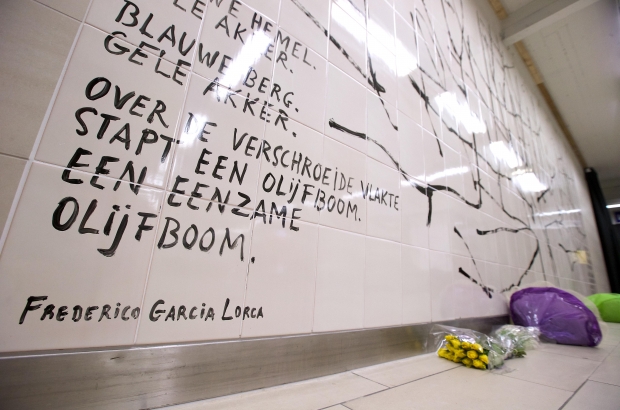
Meanwhile, a new memorial (pictured) has been unveiled in the entrance to Maalbeek station, designed by Benoit Van Innis, who created the ceramic portraits on platform level. The tiled wall, with the design of an olive tree in black on white, also features a fragment of a poem by the Spanish poet Federico Garcia Lorca, who was assassinated by Franco’s forces at the start of the Spanish Civil War in 1936. Unfortunately, his name on the wall is given as “Frederico”.
“We will fix that as quickly as possible. That’s an adjustment that can be taken care of quickly,” Van Innis said.
Photo: Nicolas Maeterlinck/Belga