
- Daily & Weekly newsletters
- Buy & download The Bulletin
- Comment on our articles
Related articles
Recent



Popular
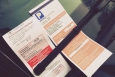


Complaints about Parking.brussels continue to rise

The number of complaints about Brussels' parking enforcement agency is on the rise, almost doubling in a year from 233 in 2024 to 450 in 2025, according to a report from the regional mediation service.
“For the past three years, parking has really been the number one source of complaints to our service, and it’s only increasing,” said ombudswoman Catherine De Bruecker. “It was time to draw some structural conclusions.”
The report contains recommendations related to both the regional parking agency Parking.brussels and the six municipalities that still carry out their own parking enforcement.
Complaints relate to consecutive fines, limited options for appeal and unclear municipal boundaries, among other issues.
Due to the high volume of reports, the ombudsman service had to temporarily set up a joint handling system with the parking agency that involved sending weekly lists and holding monthly meetings to discuss the complaints.
This enabled it to identify structural issues relating to parking policy and formulate a series of recommendations to improve the service.
One of the most common complaints was that unclear municipal boundaries caused confusion.
“It happens that certain residents are actually parked in a different municipality than assumed, which causes a great deal of confusion and can lead to unexpected fines,” said De Bruecker.
“The territorial division of parking is a real headache for users. We receive a lot of complaints from people who have paid for their parking but didn’t pay at the right place.
"These aren’t people trying to park for free. Either they had an exemption card, or they bought a parking ticket from the wrong parking meter.
"They receive fines for a simple mistake linked to the complexity of the situation."
Furthermore, municipalities and Parking.brussels do not always provide the same information.
For example, a resident of Brussels-City found a list on the city’s website of streets in the Ixelles district where, as a Brussels resident, he would be allowed to park with his resident’s permit.
Based on that information, he parked in Rue du Bailli, resulting in seven fines. According to Parking.brussels, this was a red zone where a resident’s permit is not valid.
“We’re therefore calling for the management and enforcement of parking in border zones to be better coordinated,” De Bruecker said.
“That would make things much clearer for users. Under the current system, there’s too great a risk of errors.
"Some residents misunderstand the geographical scope of the resident’s permit for their neighbourhood and repeatedly park in an adjacent sector of the same municipality, for which they have no exemption."
There were also many complaints about successive fines.
“Take, for example, someone who parks in a prohibited area: it’s only after about 10 days that the person is notified of the offence via an initial notice,” said De Bruecker, noting that if that person has parked in that spot in the meantime, further fines may follow for the same offence.
“So someone could receive multiple fines for an offence they didn’t even realise they had committed in the first place.”
According to De Bruecker, there are cases of users who have ended up with hundreds of euros in fines due to such situations, and the ombudsman service is calling for an end to the sending of successive fines for the same offence.
The mediation service is also concerned about the introduction of parking zones where an SMS or an app are the only payment options.
Such mobile-only payment methods are being introduced as a gradual replacement for traditional parking meters, where payments can still be made by bank card or cash.
“Not everyone has a smartphone, and sometimes you might have left your phone at home or the battery is dead,” said De Bruecker.
“Moreover, paying via an app for a service provided by external private companies entails additional costs for users.”
Another common complaint concerned the way in which disputes raised by drivers were handled. In several cases, the points raised by the user had not been thoroughly investigated.
“When people contest a fine with Parking.brussels, they receive an initial response and if they aren’t satisfied with that response and try to engage with the parking agency, that’s when the dialogue breaks down; they receive no further reply,” De Bruecker said.
“What we’re asking for is that the user’s dispute be thoroughly examined before they are sent away or the collection procedure is initiated.
"We’re also asking for the fine itself to be better justified: to specify the zone and the rule applicable to that zone.
"At the moment, only the location and the time of the offence are stated, but not a detailed justification, which also generates a lot of questions and consequently calls to customer services. We could be more efficient by improving the justification."
Also included in the list of recommendations are the so-called "tolerance rules", or informal agreements applied internally by parking attendants. For example, residents are given 10 minutes after parking to start their paid session. The ombudsman notes that while there are several such rules, they are not made public.
“It would be better if they were, so that users know more clearly where they stand,” said De Bruecker.
The ombudsman’s office also highlighted two technical shortcomings: in the event of offences, the reason why a fine was issued is not stated on the notification letter; and when someone pays a fine but uses the wrong reference, the amount paid is refunded without warning.
As a result, some people only realise too late that a mistake has been made, leading to additional costs.
The recommendations have already been submitted to Parking.brussels, which acknowledged that there were difficulties in zones at municipal boundaries.
A new system, which will ensure clearer rules, is currently in development. The roll-out will take place in three phases, starting this spring.
The agency said it had also revised its internal management procedure for complaints.
“If the member of the public maintains their dispute despite the explanation provided, the debt collection service takes over the management of the case,” the agency said in a response to the recommendations.
“That service then analyses the situation, checks the factual and legal elements and, if necessary, assesses the possibility of initiating a debt collection procedure through legal channels.”
Regarding the mobile-payment only parking meters, Parking.brussels said that this is “a choice for the municipalities”, and that the agency merely provides support.