
- Daily & Weekly newsletters
- Buy & download The Bulletin
- Comment on our articles
Related articles
Recent



Popular

Brussels region sues animal welfare organisation Gaia over recent campaign
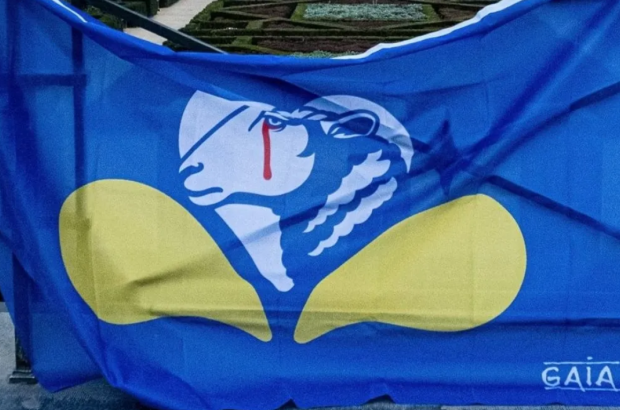
The Brussels region is taking Belgian animal welfare organisation Gaia to court over a recent campaign, which involved producing a fake Brussels region flag depicting a sheep crying a tear of blood, as well as a fake letter allegedly signed by minister-president Rudi Vervoort (PS).
The region is claiming damage to its image and penalties for the campaign, which only lasted a few days last September, RTBF reports.
During the communication campaign, the organisation reimagined the Brussels flag in an aim to protest against the fact that Brussels had still not banned ritual slaughter - done without first stunning the animal - unlike Flanders and Wallonia.
About 1,500 of the flags, dubbed "flags of shame" by Gaia, were hung in several locations across the capital. The organisation also printed 340,000 leaflets featuring a satirical text purporting to be signed by minister-president Rudi Vervoort welcoming the change of flag.
The Brussels region summoned not only the association to appear in court, but also the publisher responsible for the leaflet, Michel Vandenbosch.
The region is demanding the removal of all visuals still present on social media and the Gaia website. It is also claiming €6,000 in damages and a penalty of €10,000 per infringement.
“We have requested the cessation of the campaign to misappropriate the institutional identity of the Brussels region,” said Geoffrey Ninane, the region's lawyer.
“There’s nothing wrong with conducting a campaign to assert certain political opinions. That’s not what Gaia is being accused of in this case.
"What it is being accused of is misusing the institutional identity of the Brussels region, as well as that of the minister-president, by ultimately using his name and signature in the distribution of leaflets."
Ninane is citing Articles 1382 and 1383 of the Civil Code and claims there is civil liability.
“While freedom of expression is recognised, there are certain limits to this freedom of expression,” Ninane said.
“It’s within this framework that the Brussels region is defending its interests here, precisely to ensure that communications to the public do indeed come from the region and not from a third-party association claiming to act on its behalf.
"Confusion has been created among the public. The region has included in its case file various testimonies from citizens who have indeed been misled by this broadcast."
Gaia’s defence team questioned these alleged testimonies.
“The region has not demonstrated that there was a real disturbance to public order or even that the confusion that may have been created is widespread or of more than symbolic importance,” lawyer Maître Olivier Sasserath said.
“The region's claim contains two emails from residents and one from a member of parliament from the same political group as the minister-president, who said he had received questions from a few people.
"As there is no concrete evidence of any real negative impact on the population, there is no reason to impose or allow the measures that are being requested."
Gaia’s defence noted a problem of proportionality "that arises in the context of freedom of expression, which is a fundamental right guaranteed by various international texts, and the proportionality of the measures requested by the Brussels region".
“These measures are in fact a request for a total ban on the continuation or resumption of the campaign,” the organisation’s defence argued.
“The campaign has ended, but the region is nevertheless requesting that all information on the subject be removed. In our opinion, this is totally unjustified in view of the arguments put forward by the region.”
Citing established case law from the European Court of Human Rights, Gaia is arguing that "there must be proportionality between, on the one hand, the measures requested and, on the other hand, the actual damage caused".
“In general, when it comes to discourse on public policy, the European Court of Human Rights is extremely vigilant in ensuring that no censorship can be imposed,” said Sasserath.
“There has been no concrete evidence of any real negative impact on the population during this campaign. There is no reason to impose or allow the measures that are being requested.”
Gaia also argues that the use of Vervoort’s photo and signature, which the region argued confused people, was clearly satirical.
“When you read this leaflet, you see that it is completely different in style from the communications issued by the Brussels region, in that it talks about pride in having a bloodstained flag and things that are more reminiscent of the 19th century, using the warlike language of that era, rather than the language of current government communications,” said Sasserath.
“I cannot help but see the region's action as a knee-jerk reaction to a campaign it didn’t like. An attempt at censorship? I think so.”