
- Daily & Weekly newsletters
- Buy & download The Bulletin
- Comment on our articles
Related articles
Recent



Popular



Brussels Pride parade draws 216,000 people
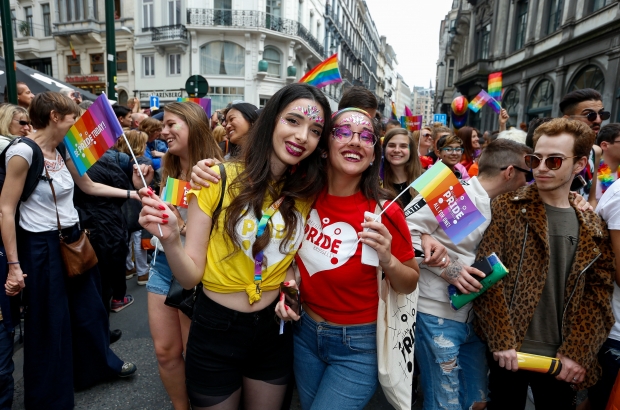
The 30th edition of Brussels Pride drew 216,000 people to the Belgian capital on Saturday.
This year’s theme was "when times get darker, we shine brighter", as organisers sought to show their support for the LGBTQIA+ community at a time when their rights are under threat.
The parade set off from Mont des Arts and returned there later to culminate in a large party.
A large and festive crowd took part in the procession, combining calls for political action, music and a celebration of diversity.
Police spokesperson Ilse Van de Keere said the march took place in a “generally festive and peaceful” atmosphere, though a small group of demonstrators protesting against the N-VA’s participation in Pride did disrupt the parade at several points.
The police intervened and carried out 29 administrative arrests.
Additionally, three artists who performed at the event were the victims of homophobic violence after being attacked following their performance by about 20 young people who beat and verbally abused them.
“After our performance, we walked back to our car and were attacked by a group of children. They were perhaps 14 years old,” said Diva Beirut, one of the victims, on Instagram.
“They threw a bicycle at me, pushed me to the ground, hit me and hurled abuse at me,” Beirut said.
“I’ve never experienced anything like this before, and I’ve been a drag queen in Lebanon for 10 years.”
The Brussels Pride organisers expressed their support for the three via social media, saying: “No one should ever have to fear for their safety because of who they are. This is why Pride is still necessary.”
The Brussels Capital-Ixelles police zone is currently unaware of any complaints regarding the incident, but indicated that its LGBTQIA+ liaison officer has invited the victims to file a complaint.
Chille Deman, who works with the Rainbow Ambassadors association and is one of the founders of the first Brussels Pride in 1996, told RTBF that the event has evolved over the years as LGBTQIA+ visibility continues to grow.
“In 2000, there were elections and a new majority came to power in Brussels under the leadership of Freddy Thielemans,” Deman said.
“He welcomed Pride with open arms and it became part of Brussels’ wider programme. That year, we had the boulevards to ourselves for the first time, with huge banners hanging above the streets.
"We were received at the city hall and the Brussels parliament. At the time, it was truly something wonderful. I even cried.”
Belgium has seen significant legislative advances in LGBTQIA+ rights since the 1990s. Homosexuality was decriminalised in 1972 and, in 2003, the country became one of the first in the world to legalise same-sex marriage.
These developments have made Belgium one of the most progressive countries in the world when it comes to LGBTQIA+ rights, but organisations such as Fiertés Namuroises emphasise that achieving these changes took years of campaigning.
“Rights never come about on their own,” the organisation states, and despite the progress made, discrimination still persists today.
Today, Deman focuses on raising awareness among care home staff and residents of the realities faced by elderly LGBTQIA+ people, who are often confronted with isolation or the fear of having to hide their identity there.
“We provide training, mainly for staff, as well as activities for the residents,” Deman said.
The Rainbow Ambassadors association is also working on a unique project with the City of Brussels. “We’re in negotiations with the city to set up homes where six to eight LGBTQIA+ people could live together and receive certain home care services,” Deman added.
For Deman, visibility remains essential in the face of rising hate speech and violence still targeting LGBTQIA+ people in Belgium and elsewhere in Europe, and Pride is a way to ensure that visibility continues.
Organisers of the this year’s Pride noted that attendance figures for the 2026 event were calculated using anonymised mobile phone data collected by Proximus.