

- Daily & Weekly newsletters
- Buy & download The Bulletin
- Comment on our articles
Art centre Wiels marks 10 years of doing things its own way
“I remember the day I was first invited to visit this building, when it was still dilapidated,” Dirk Snauwaert says of Brussels arts centre Wiels. “It was a cold, windy Sunday in February. The sun was shining and the light was amazing. That’s when I knew that these large, high rooms were just begging for art.”
In January 2005, he accepted the offer to become the first artistic director of Wiels, an institution he would have to build up from scratch. Snauwaert, who is still at the helm, was 41 when he took the reins and already had an impressive CV, having worked at what is now Bozar in Brussels, and later in Munich and Lyon.
Wiels was going to be what is generally a described with the German word Kunsthalle: a place that organises exhibitions but, unlike a museum, doesn’t have its own collection. “But we wanted to be a bit more than just a Kunsthalle,” Snauwaert says. “That’s why we set up our residency programme.”
Wiels has nine fully equipped working spaces that are put at the disposal of artists, be they Belgians or foreigners, for six or 12 months respectively. “This means we house the whole chain of the art practice: from coming up with an idea to showing the finished works.”
Positive choice
To distinguish itself from other local museums and art galleries that show contemporary art, Wiels has carved out its niche. “Two forces are at play here,” Snauwaert says. “I like to work by exclusion: not doing the things that others are already doing.”
It’s also a choice that works, he emphasises, for the shows he prefers. “I think one of our characteristics is the essay-like exhibition. An exhibition that’s not chronological or retrospective, but where you ask the artist: show us your programme. It’s a kind of show that you don’t see in the classical institutions – like Bozar, just to pick one.”
But there is more. One of the most striking elements of local curating, he says, “was the relative absence of significant female artists in the programming. So we tried to readjust that. And one of the main questions Wiels has been asking over the past decade is: what about the multicultural society, what about our mixed demographic?”
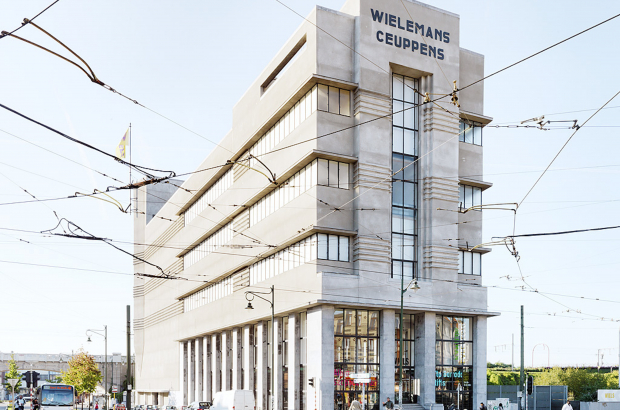
The space itself has an important impact on the exhibitions. The building is vertical, meaning that shows that have been conceived horizontally, as a parcours, have to be rethought completely.
It is, of course, an exceptional building. Designed in 1931 by Art Deco architect Adrien Blomme, it used to house the now defunct Wielemans-Cueppens brewery.
Wiels is in the municipality of Forest, a kilometre south of Brussels South station. It’s squeezed between the railway and both a prosperous and a poor neighbourhood.
“It’s difficult to exactly say how strong our impact on this part of the city is,” says Snauwaert. “But we have always worked on it proactively. I still think we attract too few visitors from the neighbourhood, but that’s an element we don’t have much influence on. Schools and other organisations have a greater impact on that, but culture isn’t their main priority. Maybe our world view doesn’t match with their at times somewhat more religiously influenced ideas.”
Showing the future
But Snauwaert points to Wiels’ social-artistic programmes (“often without extra financial support”) and its employment policy, which prioritises people from the neighbourhood and surrounding municipalities. It also works with Actiris, the Brussels employment agency, for example, and new employees get language and behaviour courses.
“During an exhibition, they are the first contact with the visitors. That audience is quite international,” he explains. “But our stewards are often even more international: They’ve come from further away, sometimes even by foot. We have more and more refugees among our staff. All in all, our crew is a good reflection of Brussels’ inner cities.”
This, he says, “is a signature of Wiels. We could have done it differently, employing students, for instance, but how we do it is a definite ideological choice”.
Snauwaert seems happy with Wiels’ place in the Brussels art world, literally and metaphorically. “We are in a suburban area, and that really makes a difference: We don’t have to neurotically serve the tourist audience. Even so, compared to some other institutions we have a nice number of visitors, maybe 50,000 per year.”
Though he’s not going to pretend, he say, “that I wouldn’t love to double that figure. Of course, you can’t compare us to the more centrally located museums. They’re building on the past, while we show the future”.
To celebrate its 10th birthday, Wiels presents The Absent Museum, an exhibition that fills the whole building, including the roof, and even two adjacent buildings. The title is a reference to the absence of a museum of contemporary art in Brussels.
The opening of such an institution has been under discussion for years. “It’s very deliberate that the new show is called The Absent Museum. The museum is absent, and that’s not the same as non-existing.”
Snauwaert is referring to the Fine Arts Museum in Brussels, which has almost completely hoarded its modern and contemporary art. “It’s literally a crumbling building that has been neglected for 40 years.”
And he adds: “Anyway, I don’t think the Fine Arts Museum is the place to host contemporary art, since it propagates a homogenous societal vision. Such a society hasn’t existed for decades, but some people still propagate it for their own benefit.”
Photo: The Wiels building, a vertical space designed by Art Deco architect Adrien Blomme in 1931, originally as a brewery ©Wiels





Comments
A bit off the beaten track but access by tram is quite easy. The building is splendid and the exhibitions always interesting. You can fortify yourself in advance, or relax afterwards, in the ground floor cafeteria, which still has the huge copper tanks where beer was brewed.